Showing posts with label CRTC. Show all posts

Friday, April 26, 2013

CanCon

While our two dominant political parties perennially argue about the perils of the fairness doctrine, other nations handle their media quite differently. In Canada for example, they extend this idea of fairness even into the content of music programming. They call it "Canadian content" which is abbreviated as CanCon, cancon or can-con. More here.

Canadian content refers to the CRTC (Canadian Radio-television and Telecommunications Commission) requirements for broadcasters to air a certain percentage of content that in some way is Canadian. The term broadcaster here is broad, in this case in includes radio, television, cable and and satellite. but there are loopholes the content  has to be at least partly written, produced, presented, or otherwise contributed to by an actual Canadian. The correlation is tracked by MAPL (Music, Artist, Performance and Lyrics.) Yes... even the words can be Canadian. So in the words of one analyst, the definition is "squishy."  Craptastic.com wrote a seething indictment of the rules here. I quote it below:
"In the States you have one hit wonders. In Canada you have no hit wonders getting constant air play solely for being Canadian... Thanks CanCon...thanks a fucking lot."

But how much and how often is actually somewhat complicated. They have broken radio stations and the music into categories. While every licensed radio station is required to air a percentage of its weekly music programming to CanCon required amount depends both on the type of radio station and the type of music it broadcasts. There are special exceptions for Nostalgia and Oldies formats because of the playlist limitations with a mere 2% requires for stations focused on pre-1956 tracks. There is also special dispensation for college stations on a week-to-week basis because of the variability of new release schedules.

Popular Music (Category 2) 
  • English-language and French-language stations must ensure that at least 35% of the Popular Music they broadcast each week is Canadian content.  
  • Commercial radio stations also have to ensure that at least 35% of the Popular Music broadcast between 6:00 a.m. and 6:00 p.m. Monday to Friday is Canadian content. 
  • CBC / Radio Canada stations must ensure that at least 50% of their Popular Music selections broadcast each week are Canadian content.  

Special Interest Music (Category 3)
  •  English-language and French-language commercial radio stations must ensure that at least 10% of all Special Interest Music broadcast is devoted to Canadian selections. They’re also expected to ensure that at least 25% of all concert music (subcategory 31) and 20% of all jazz and blues music (subcategory 34) broadcast is devoted to Canadian selections.
  • All commercial radio stations have to ensure that Special Interest Music selections, including Canadian content, are scheduled in a reasonable manner throughout the broadcast day.
  • When these stations renew their licenses, they’re expected to propose an increase in the Canadian Special Interest Music they play – except in the case of concert music or jazz and blues. 
  • Native radio stations must ensure that 10% of all Special Interest Music broadcast each week are Canadian selections.  
  • Campus and community radio stations must devote at least 12% of all Special Interest Music broadcast each week to Canadian selections. 
  • CBC / Radio Canada stations have to ensure that at least 20% of all Special Interest Music broadcast each week is Canadian content. 
 Other countries employ similar quota systems such as Australia, Philippines, Mexico, Nigeria, Israel, South Africa, Jamaica, Venezuela, New Zealand, Ireland and France and the rest of the European Union who share a European Union content rule superseding their domestic laws.

Monday, February 12, 2007

The Other Border Radio

The term "Border radio" Is almost always assumed to mean our southern border. But the lower 48 states boarder two nations. Both Canada and Mexico license radio very differently than us. In this case I refer to information radio. Our information stations are everywhere, they cover parks, tourism, travel, traffic, weather safety etc. But Canda only has three.

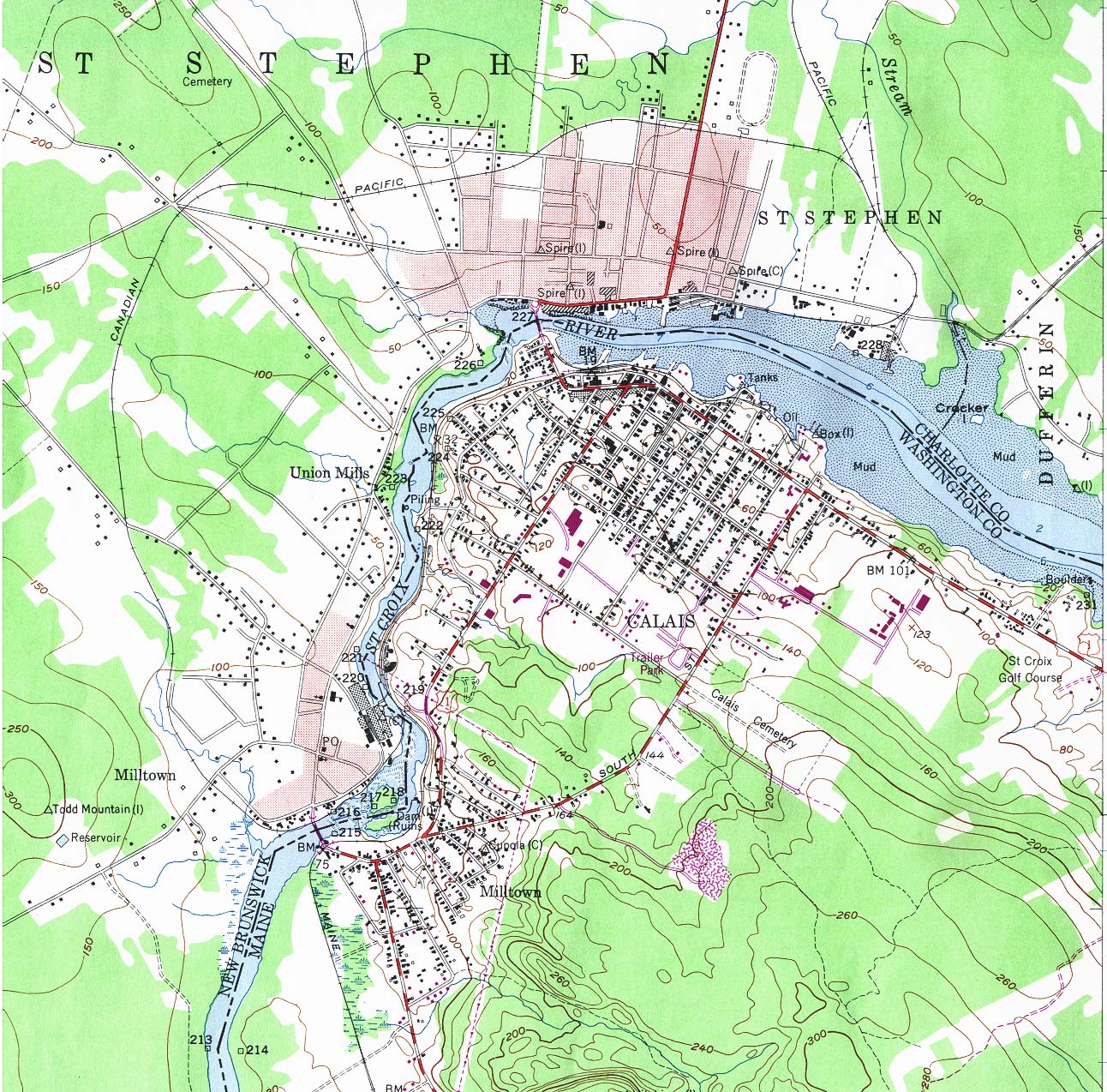
The CRTC (Canadian Radio and Telecommunications Corporation) just isn't cold on the idea. One of those three places is St. Stephen, New Brunswick. ...and what's so special about St. Stephen?

Well, it's directly across from Calais, Maine and there is a very popular bridge between the two for passing between the two countries. (Minor mention here.) The line of cars is very long and as you can se on this map marking the poorly planned snaking path, you can see why it takes forever. To be honest, I can say from experience that the search portion of the passage at the crossing takes mere minutes. The obstruction of the journey is the nutty snaking of the road there, like at the airport metal detector.

So, despite the fact that St. Stephen on their side of the border is so small it only has one radio staitn of it's own (the U.S. side has 4) It was the Canadians that swooped in to broadcast traffic and travel information to the stranded travelers.

Here are the four Canadian information stations. You'll notice it's all related. The 4 stations reach between the crown of maine and a the smallest province of Canada. Apparently American tourists are trusted to travel throughout the rest of Canada unmanaged, but this northern passage requires a little assistance.

96.5 St. Stephen Information Radio, (St. Stephen, NB) Play loops of customs and border crossings, weather and local St. Stephen tourist info. They have signs along US1 in Calais, Maine, asking you to tune to 96.5 for customs info. No calls are ever used.

90.1 Central Nova Scotia Information Radio. Covering an area between between Amherst and Truro they run tourist information, weather, traffic reports. It can be heard along the Trans-Canada highway throughout western Nova Scotia. There are signs along the Trans-Canada advertising this station.

101.9 Moncton Information Radio, (Moncton, NB) It too runs local traffic reports weather and local information.

93.9 Confederation Bridge Information Radio, (Prince Edward Island) It runs traffic reports for the eleven mile bridge to PEI. It's programming is very similar to the other FM stations above.

Thursday, July 06, 2006

Christians attacking indians again...

It's only been a thousand years... but the Christians won't layoff.
I am very sympathetic to the native Americans. They want to build casinos... let 'em. They are more deserving of reparations than any other minority group. So when a satcaster christian outlet tries to take a native American owned radio station to court, I don't care if they're Canadian or American. I know whose side I'm on.

This is a battle between a Vancouver, Canada based Aboriginal Voices Radio Inc., and KWPZ-FM Lynden, Washington owned by Crista Ministries. [KWPZ recently changed called from KLYN]

Crista argues that they are losing listeners they should reach rightfully within their protected contour. Their contour crosses the U.S./Canada border. They of course have no rights north of that border. None. They also argue that it will cause interference within the US portion of their coverage area. This may have some truth, BUT they Also own KCMS 105.3 which blankets the entire Seattle market with one 63,000 watt signal and three repeaters. This signal is in no danger of any kind. None-the-less KWPZ mustered more than 7,000 listeners enough to file interventions opposing the the application.

Aboriginal Voices argues that the 50,000 native Americans in the Vancouver market (not the U.S.) deserve a broadcast media voice. That and KWPZ is not entitled to receive the same technical protection in Canada as Canadian services get. The Aboriginal Voices radio website is here.  The CRTC found in favor of AVR of course.

But there is a magic detail here. In 2001 AVR filed not for 106.3, but for 90.9. In the CRTC's own language "in the Commission’s view, the use of 90.9 MHz by AVR did not constitute the best possible use of that frequency. " You can read it here. And what's adjacent to 90.9 near Vancouver? nothing. nothing at all. So four years ago the CRTC made a chess move to pick this fight pretty knowingly. 106.3 isn't' even that great a signal. It's second adjacent to Canadian public radio outlet CBU 105.7. More here. I don't know why, but I can say that Canada has a totally different approach to defending their RF border than Mexico does.