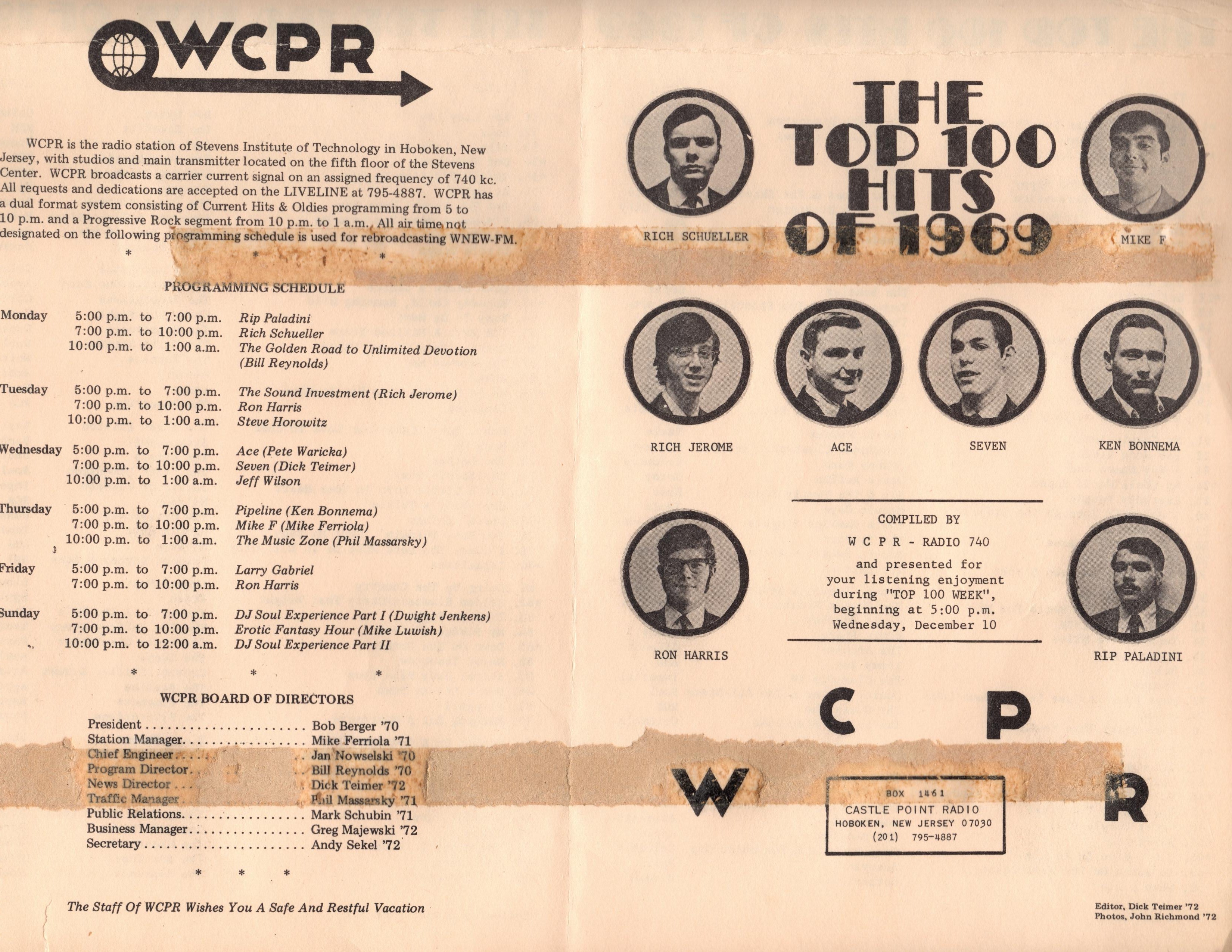
Wednesday, October 30, 2024

Calling all WCPRs

There have been a lot of different WCPRs over the years. Today there are three: 1450 WCPR-AM in Coamo, PR which first signed on in 1967, also 97.9 WCPR-FM in D'Iberville, MS which signed on in 1992 and then my favorite: 740 WCPR the college radio station of Stevens' Institute of Technology. My research indicates that it was founded in 1961. There were also a few historic WCPRs, all to be untangled.

Sometimes listed at 530 AM, the station never actually had an FCC license. There is a legend of an SS Steven's and a related FCC raid of WCPR somehow using that floating dormitory to boost their signal. The boat was real, [SOURCE] but the rest remains an uncorroborated legend, though very colorful. If it helps you imagine it, the SS Steven's did have a radio room which may have been the origin of the tall tale where they "lost" their FCC license.

In 1967, the first year the SS Steven's housed students, WCPR was already broadcasting on 1450 Khz in Coamo, Puerto Rico. That means at the very least, those calls were not available. However at the time WCPR was using the call letters WSRN; confusingly also a carrier current station at Swarthmore College in Philadelphia  at the time. References between 1957 and 1966 in multiple publications confirm.It appears their WCPR calls were adopted in 1967

Not that there was any confusion in Hoboken. Generally speaking, Hoboken hasn't been a hotbed of radio broadcasting. RCA operated WJY from Hoboken in 1921, and it's not been home to a licensed transmitter since. Purportedly WCPR was using a retired one from WAAT-AM. However, I did find that Stevens was offering radio broadcasting courses as early as 1941 so amateur and unlicensed broadcasting are certainly on the table. 


Tying it to Stevens is the hard part. If I go back all the way to the 1920s I did find one amateur license, 2AIS operated in 1925 by H.A. Thompson at Stevens Institute. The calls go back to at least 1920 with other operators, also in Hoboken: George William Stewart and Fred Britton Llewllyn. The 1922, 1923, and 1926 listings of the Citizens Radio Call Book connect 2AIS to the "Stevens Radio Club" at 521 River Street. Perhaps this is the actual origin of WCPR, not that these things tend to have only one origin, true or not. (Back in 1915 the calls belonged to Fred Dawson of Arlington, NJ)

WCPR was always a carrier current station. The campus radio station at Steven's Institute of Technology in Hoboken, NJ was not even audible in the one square mile area of Hoboken. They were geographically situated such that they might be on the same radio dial as the biggest, most desirable non-commercial playlists in America: WFDU, WNYU, WSOU, WKCR, WHCR, WFUV, WFMU but they were only audible in select locations on that campus. 


But because the kids at WCPR were highly organized, they were reporting their top 5 to Billboard magazine in the early 1970s right along side what we'd later call "core" reporters like WWUH, WVKC and WLSU. That's pretty amazing. Back in the 1960s they rebroadcast WNEW off hours. Hey, when you're not broadcasting, there are no rules! [SOURCE] Then in 1976, a Brooklyn pirate radio station re-used their call letters! Was it out of ignorance or was it an homage? we may never know. But that pirate and the college station both appear in various books by the legendary Andrew Yoder.  [SOURCE] There are multiple sources but the very best is a column from Popular Communications. I quote all three relevant paragraphs below:

Tom [Macko] also goes on to tell about a station he heard last December. The station, Tom says, broadcasts on 1620 kHz from "some where in New York... Obviously it is a pirate station. I heard it playing rock music and conducting what were announced as transmitter tests. The station gave a phone number, which I called. A young man answered. We talked for a while but he said he couldn't answer some of my questions about the station's location and details. This was very interesting. Probably the FCC will shut down the station by the time this report gets printed."

You betcha! That's,exactly what happened to this rather ambitious pirate ambitious pirate station used the call letters WCPR. Actually it took a number of weeks before complaints of this unlicensed operation reached the Federal Communications Commission. And during that period,the signals of this pirate station, just above the normal medium-wave AM band, were heard as far north as New Brunswick, Canada and as far west as Illinois.

But, when the FCC did learn about WCPR's illegal operation,it took just one night of radio direction finding effort to pinpoint the station's location, in an apartment building in Brooklyn, NY. The transmitting equipment was confiscated and at this writing no decision had been made as to whether to charge the offenders with a criminal violation.

So that's four or more WCPRs detailed above. But I do have just one more which is perhaps just a misnomer: In the 1990s there was another WCPR which reported to CMJ for years. It was ostensibly based in "Peona, IL" later this was corrected to Peoria, IL. (Only one of those towns actually exists of course.) For a long time I was unable to identify that radio station. It could be our WCPR in Hoboken with incorrect metadata, or some other even more obscure carrier current station. A 1986 issue of "The Stute" does claim Stevens was reporting to CMJ at least in the late 1980s adding to the confusion. [SOURCE] In some issues both stations charts appeared side by side.

In a single issue of CMJ in 1999 I found the mystery station reporting under different calls in different parts of the issue: adds, metal chart, top 30 etc. The Peoria station was now using the call sign WRBU, That's was and very real carrier current station at Bradley University, a campus also home to the public station, WCBU. (Oddly today WCBU is operated by WGLT.) There is very little information online about this station. Today Streema lists WRBU as no longer streaming. A 2014 issue of the Scout [SOURCE] lists the station manager as Ethan Hoerr in a short article about campus group ads. Their social media posts peter out around November of 2022.  Other shows were posted later directly on YouTube but those also peter out. Below is the description they were using online around that time.


WRBU The Edge is Bradley University's Student owned and operated college radio station. Here at The Edge we strive to provide quality radio programming you won't hear on any other major station. Shows are developed and hosted by students that are unrestricted in format. This results in a wide range of programming that gives WRBU a creative and original edge over all other college radio stations (yes, pun intended).

Their old URL was buedgeradio.com and thankfully there are multiple captures on the wayback machine. But most importantly in addition to streaming, it confirms they were available on Channel 3 on Bradley Campus Cable and also on 97.7 FM on Bradley Campus in Peoria, IL —that's the carrier current signal. The station has at least two separate eras. It first started around 1968 at WBUR and ending in the late 1970s. Then it was rebooted in 1987 driven by faculty advisor Tom Richman. Early station managers include Jeremy Styniner. They are able to trace the station in that form back to the 1960s broadcasting 5 hours a day on carrier current. Bradley University also has it's own Amateur Radio Club with the calls W9JWC and a public television station WTVP which all may have shared staff and/or facilities at different times. Posts on their new website stop in April of 2022. It ends abruptly with two videos on the history of The Edge. The production value is decent, clearly NPR-inspired. It's quite good.

The problem with this 1980s reboot of WRBU is that all print sources already refer to it as WRBU. The video histories also refer to it only as WRBU even thought their CMJ reports list them at WCPR for another decade. The 2nd episode of the history confirms they were a carrier current station even in the early 1990s. On United Artists cable FM at 99.5 they could be heard in Bartonville, Maxwell, Bellevue and Norwood Illinois. This expansion, while driven by cable television increased their coverage wildly beyond their campus. In pictures I do see a CMJ poster in the background. A 1998 article confirms they were moving to a part 15 low power broadcast and that they were re-branding as "the Edge" and abandoning the call sign WRBU. My theory is that they attempted to update their calls with CMJ and realized that it was incorrect, and some limitation kept them at 4 letters. Why they didn't go with EDGE, I'll never know.

Looking at all the overlapping timelines, we can say definitely there were at least four WCPRs in 1998, its a very popular call sign. But being unable to connect the two stations WRBU and WCPR there is the possibility that there was just one more, unless this was always a typo, or yet another very clever pirate. As always... there's a mythos there.

Monday, October 21, 2024

Around The Samovar


A samovar is a metal container traditionally used to boil water for tea. There's a central tube in which you burn coal or wood to heat the water. Many Russian samovars have a konforta, a sing-shaped attachment that holds a teapot filled with tea concentrate. They're often very decorative.

The first reference I ever read misnamed the program, perhaps deliberately. It was in a truly excellent book Poland Under Black Light by Janusz Anderman. My English translated copy is from 1985.

"...a shop trainee showers people standing in line with orangeade and hides, laughing, behind the empty shelves; no one reacts; many newspapers carry reports on the bear that has shown up in the Tatra, it is affectionately referred to as Teddy, and a special correspondent reports on it for the Express; on Polish radio there's a program "Teatime Round the Samovar".

The Program at first seemed not to exist. Then I found the name variation. The was a Russian music program named "Around the Samovar."With the correct name I found multiple references. the most detailed is the March 12th 1934 issue of the Jewish Daily Bulletin in the Kilocycles column by George Field. [SOURCE]

"WEVD presents two other worthwhile programs, at 10:15 p. m. the University of the Air will be in charge of Professor Ernest Sutherland Bates who discusses "Coordination in our Present-day Life" and at 10:30 Zinoida Nicolina, soprano, Simon Philipoff, balalaika artist, Zam's Gypsy orchestra appear on Around the Samovar program."

 A 1930 issue of the Arriba record lists the program on the Columbia System at 9:30 PM Eastern Standard Time. In 1931 the Alabama Digital archives list the program in July of 1931 at 7:00 PM. [SOURCE]  The May 1931 Cincinnati Radio Dial lists the program at 10:30 on WKRC. It gives the impression that the show moved around often in it's first year.  It was some time before I found anything other than listings on radio schedules. 

The February 1931 issue of "What's On air" answers our origin questions. [SOURCE]. Columbia cancelled the program Majestic Curiosity Shop and mailed a misprint of their schedule for that month. Listeners were displeased with the mix up but we now learn that "Around the Samovar" debuted Sunday January 4th, 1931 and got their first earful of Peter Biljo and his Balalaika Orchestra. Purportedly Biljo was born in Leningrad, today called Saint Petersburg in 1893. (They were sometimes also called the Bilji Balalaika Orchastra.)  The Ogdensburg Republican Journal from that same week made note of the change in the Daily radio Highlights column by C. E. Butterfield with the arcane note

That issue of the Cincinnati Radio Dial also lists off more performers: Valia Valentinova, contralto; Eli Spivak, baritone; Eliena Kazanova, violinist, and Peter Biljo, director of the balalaika orchestra.The Radio Pictoral Spring 1931 issue took a stab at describing the program. [SOURCE] It listed the above performers and a very short description: "Around the Samovar" instead of the Curosity Shop, WABC chain at 9, with, the Gauchoa Going on at 10.30."  It included a list of the stations that carried the program: WHEC, WKBW, WEAN, WNAC, WORC, WPG, WJAS, WLBW, WMAL, WCAO, WTAR, WDBJ, and WADC. But the Cincinnati Radio Dial had more description:

"Each broadcast of"Around the Samovar" presents some new and novel phase of Russian music or some charming folk song that introduces the listener to new musical enjoyment. The programs are carefully prepared and rehearsed before going on the air, although they give one an impression of gay spontaneity."
The only problem with that story is that it very clearly appears on a WABC schedule at 9:30 PM, March 22nd 1930. [SOURCE]  It aired between the Nit Wit Hour and the Paramount Publix Hour.  More here on that Nit Wit Hour. [LINK]


The October 3rd, 1929 Brooklyn Times Union also listed the program with a complete song listing, and cited all solo performances.(below)  I had to look up Chankamanka; it appears to be made up or misspelled. Further backing up the 1929 date is a thesis paper by Martin Edmund Kiszko The Origins and Place of the Balalaika in Russian Culture. 


Kiszko goes on to describe the program in more detail then anything else I ever found. [SOURCE] It includes two extracts from a September 22nd 1929 script for the program from the Kasura collection. University of Illinois. (See pages 101 and 102.)

"One of the most popular radio programmes of the late twenties, when recordings of Russian music hit their peak, was Around the Samovar, illustrated here with copies of the original 1929 scripts (document 2). Around the Samovar featured Peter Biljo's Balalaika Orchestra and Soloists. The show's radio scripts of 1929 display a repertoire primarily made up of ballads, gypsy songs, popular Russian dances for orchestra,arrangements of Russian and European art music, and violin solos. Predominant is the use of the baritone or soprano vocalist accompanied by orchestra."

It also appears in a June 1930 WABC schedule in the Radio Digest. It seems clear that seasons of the program aired from Spring of 1929 through 1930. Wireless World even paused to call it "A little Russian Programme" in their Future Features column of 1929. That may be it's actual debut. Also on WABC in 1929 was the program "In a Russian Village." It was already airing weekly in June of 1929 , and debut on the network at 8:00 June 7th. This appear in the Encyclopedia of American Radio, 1920-1960 by Luther Sies. It's short description states that it aired in 1929 and 1930 on CBS, featuring Peter Biljo and his Russian Musicians. It appears to be very similar to the Around the Samovar program lacking only the bevy of vocalists. The 1930 Who is Who in Radio describes Peter as the Director of Russian programs at Columbia Broadcasting.

The book The Ultimate History of Network Radio Programming by Jay Hickerson provides a bit of an Epilogue. In July and August of 1934 Biljo also directed the program Balalaika Orchestra aka Samovar Serenade for CBS. Then Peter Biljo pops up in 1938 advertised along choice liquors in a Russian restaurant advert.Sometime between 1934 and 1938 Peter's radio career came to an end. 

Peter Biljo died in Woodbury, CT in 1963. His earliest 78 was released by Brunswick in 1928. More here. The name of his radio program was borrowed by other musicians for their songs and albums including Leonid Bolotine, Vasily Andreyev even writer Bill Sarnoff.  The earliest appearance of his name is a 1926 issue of Billboard index of "legitimate" stage. This notes a performance of his balalaika Orchestra at Aeolian Hall backing vocalist Nadiejda Plevitzkaia alongside pianist Max Rabinovitch.  In an exciting twist it was later found that Plevitskaya was recruited by the NKVD (soviet secret police) he was arrested and eventually imprisoned for espionage in France. It's the basis of the French film Triple Agent (2004).

But getting back to the start of this query, how did Janusz Anderman hear this program having been born in 1949 in Poland? He's about 75 years old and still writing. His last book was Shaving of Losers published in 2021. He worked at Radio Wolna aka Radio Free Europe in the late 1970s. He also published the radio play "Stadion" in 1989. It's possible he became aware of those early American Russian programs possibly though radio Wolna or the then famous story of Ms. Plevitskaya. He's still alive today... Perhaps I should ask him.

Monday, October 14, 2024

DJ Shorty Fincher

I bumped into Shorty Fincher before, reading about Lucky Lang. Shorty was actually named Luther Clark “Shorty” Fincher and he was born in 1899 in Iukia, MS according to his biography in this song book. I am aware of one other Fincher song book and it's dates with a signature to 1941. [SOURCE] At that time he was on WORK in York, PA. I suspect my song book is the older of the two, being more plain, having possibly a 1937 or 1938 publication.

As is often the case his obituary reveals more information than any other source. He died in 1958 and was 58 years old so his year of birth is accurate. Had he lived to the following November he'd have been 59. At the time he was operating Valley View Park in Hallam, PA. He was also a DJ on WGCB in Red Lion. The obit is probably the source for the alsobooks.com information stating the following

"Fincher came to York county in 1940, and his large car with steer horns on the radiator soon became a common sight. For a time he had a music group called Shorty Fincher and his Prarie Pals. He was heard on WORK and WNOW radio in his early years."
It gives the town he was born in as Iuki, MS which is not what the song book says. I am assuming they're both spelling variations of Iuka, MS. Regardless the family moved to Anniston, Alabama, when he was one year old. He was survived by his wife Alexandra "Sallie" Fincher, four sons: James, Fred,  and Donald; and a daughter Nellie named for his mother. the obit goes on to name all his siblings but hiding his sisters names behind their husbands as a Mrs. so they're not worth including. it was more interesting that many still lived around Anniston, AL but some were local to York or Philadelphia. More here.

One of 14 brothers he and two others started a band, The Cotton Pickers, in 1932. The Cotton Pickers included Shorty, his brother Hamilton (who performed as the comedian "Rawhide"), Alexandra Kaspura as "Lonesome Valley Sally," Florence "Yodeling Flo" Morosco, Dolph Hewitt and Ted Buchanan on guitar.  The Cotton-pickers relocated to Pittsburgh, Pennsylvania, where they had a regular program on KQV-AM. Around then he recorded four sides for Columbia records as the "Crazy Hillbillies Band". [SOURCE] That name is due to a sponsorship from Crazy Water Crystals. He also recorded under the name Colonel Jack [Brinkley] and Shorty's Crazy Hillbillies, as well as six other sides for Okeh. 

If you didn't know, crazy water crystals were a laxative. It was disturbingly popular. The company sponsored radio programs all over the South. The Crazy Mountaineers, Dick Hartman's Tennessee Ramblers, The Crazy Hickory Nuts, The Lone Star Quartet, Shorty's Crazy Hillbillies, The Crazy water Crystal Gang, [SOURCE]  and the Crazy Water Crystal Program itself. Their ads and sponsored programs were aired on WBAP, WPTF, WBT, KRBC and several border blasters as well.

From that 1932 group Dolph Hewitt (aka Adolph Edward Hewitt) went on to a career of his own. He got into WWVA at the age of 16, over a year before Fincher. His first performed with Frankie More and his Log Cabin Gang. In the 1940s Dolph moved to St. Louis and performed at KMOX. That went well and he graduated to an ABC Radio Network slot with Pappy Cheshire’s Ozark Champions. In 1946 he joined Radio Station WLS with the Sage Riders on the National Barn Dance. He recorded several sides for Kapp and Victor records. More here.

Back in Pittsburgh, Hamilton Fincher was hired by Doc Williams as a comedian for his band, the Border Riders. Williams and the Border Riders went to Wheeling, West Virginia, along with Hamilton. Shorty Fincher followed them shortly thereafter with the Cotton Pickers and joined the WWVA Jamboree, which was broadcast on Saturday nights over WWVA from Wheeling. Through WWVA, Fincher also co-hosted his own show, the Shorty & Sally Fincher Jamboree Show, with Lonesome Valley Sally. 

 Some sources report that Shortly was operating an amusement park at Dreamers Beach in Delaware in 1949. But a 1949 issue of Billboard reports that the first Wisconsin folk music park began operation that May in West Bend, WI.  That's about 30 miles from Milwaukee. The issue specifically says that "Valley View Park, which was operated last year by Shorty Fincher, will run this year with Nemo Lippert, of the Range Riders."  That note would put Shortly in Wisconsin in 1948. Nemo Lippert was another country artist from PA. His range Riders performed on WNOW in York. He was later on WTPA-TV in Harrisburg.


 In this part of their career, Shorty and Sallie operated their own amusement park in Hellam, PA. Purportedly the park became more of a flea market in the 1960s after Shorty died. In 1953 The Emmitsburg Chronicle of Maryland puts Shorty Fincher and Sallie at a Firemen's carnival and ox roast. The York Dispatch has them at another Firemen's carnival in July of 1954. They were playing the country version of the oldies circuit, but I'm sure they had a good time. I found one obituary that stated Shorty was a disc jockey and salesman for radio station 1440 WGCB-AM in Red Lion, PA. The station signed on in 1950 so that narrows down the time frame. While Shorty died in 1958, Sallie lived until 1987 operating the park for decades after his passing. Joan Concilio of the York Dispatch has been writing a series of articles about the park's history that are highly recommended. [LINK]

Monday, October 07, 2024

Angst and Cooking (Part 2)

I had no idea this cookbook would warrant a part 2 post. But since I wrote that post in 2014 almost everyone mentioned has died. That first post is here; where I spent some time untangling all the Angst's: Alice, Helen, Roy, Bud, Lisa and I'm sure there were others. Just as the prior book was undated, so is this one. It seems intuitive that Volume 1 precedes Volume 2 but there was also a third one that lacks a "volume" appellation though it seems to precede both. Volume 2 has one magnificent difference, four pages of black and white head shots. I picked up this copy at a yard sale

The first  cookbook referred solely to WPAM. Then the first volume of this series lists both WLSH and WPAM on the cover. As you can see this one, Volume II, refers to WLSH on the cover, but mentioned WPAM on the inside text. Missing from my first post was the origin of WLSH. It signed on in 1952 as a 1,000 watt daytimer owned by Miners Broadcasting which also owned 1450 WPAM-AM and 1460 WMBA-AM. Bud Angst oversaw the construction of WLSH, so it's safe to say the Angst's were there from the get-go.  Bud died in 2016 and his obit [LINK] tells us a little more about all that:

"After graduating from high school Bud enlisted in the Coast Guard during WW2 & served as a radio operator in the Mediterranean. After the war Bud made radio his chosen career. Under the banner of Miners Broadcasting Service Bud & his partners established 3 AM radio stations in PAWPAM Pottsville, WMBA Ambridge, & WLSH Lansford. WLSH signed on the air December 24, 1952 & it's where Bud called "home" for almost 40 years... In 1977 because of FCC duopoly rules, Bud became sole owner of WLSH. Miners Broadcasting Services was replaced by Pocono Anthracite Communications & all ties to WPAM & WMBA were severed."
That really fills in most of the gaps. That Facebook page also has great pictures of WLSH. That same obit mentions the programs that led to these cook books. "Alice's Ask Your Neighbor show spawned 2 very successful cookbooks during the 1970s..." Kelly Monitz Socha at Times News dates one of them to 1978. [LINK] That's further than I got back in 2014. But the Skook News reports that it was printed in 1974. [SOURCE] It further confirms the earlier edition that I found "There was another cookbook before "Volume 1", but it only had 16 pages of local recipes." 10,000 copies of Vol 1 were printed and then 20,000 copies of volume 2.

Alice Angst died in 2020, her obit [SOURCE] confirms that she's Bud's wife and that they met in 1946. She worked at both WPAM and WLSH, where she was the host of the long-running radio talk show, Ask Your Neighbor. It's branding appears on 2 of the 3 editions. Alice and Bud had two daughters, Bonnie (Bim) and Lisa. (Alice contributes a Roman Salad recipe and another for sausage stew.)

Helen Louise (Bouslough) Angst was the WPAM host, she died in 2021. Her obit [LINK] confirmed that she was a book-keeper at WPAM in Pottsville. I had assumed the program was simulcast but all sources confirm that Helen and Alice hosted their own shows, but co-edited the cook books. I think she was Bud's sister. (She contributes a classic Brownie recipe among other items.)


I wrote enough about Bud last time he was a beloved local figure in local radio, politics and civil society in the coal country around Lehighton. (He contributes one recipe for Broken leg hot punch.) Al Sword later worked at WTHT and became a newspaper reporter. It's hard to find more information about him despite the unique name. But Walter Reabold died in 2003 at the age of 76, he had long since left radio and was the manager for Progressive Merchants in Lehighton. (His wife Sarah contributed a good donut recipe, and a meatloaf with sausage to the cookbook.) Jack Meyers remains obscure. Sales people are like that.

Mark Osif remains a mystery but Mike Berzosky was still with WLSH as late as 1982 evidences by issues of the Hazelton Standard-Speaker newspaper. The Carbon-Tamaqua Unit of the American Cancer Society had it's seventh telethon back in 1986 and that too listed Mike Berzosk, though it's the last time I can find his name in print. He hosted the The Dutch Trader radio program, and it ran for at least 20 years so that makes sense. Jerry Tray pops up in a few sorts articles in the late 1980s, but most prominently in 1980 in a Pottsville Republican newspaper article about an FCC investigation putting him at WPAM and WZTA under Curran Communications apparently after leaving WLSH.

"Another former Curran Communications employee, Jerry Tray, told The REPUBLICAN that he had been ordered on numerous occasions by James J.  Curran Jr. to slant the news. Tray, who worked at radio station WZTA, Lansford, and who was fired in June, 1979, for having a "bad attitude..."

I found one great article about Howard Ondick, the man had guts. When ordered by a judge to stop recording a public meeting Ondick said "no."  Hilarity did not ensue. But under pressure in a room of reporters the prison commission backed down. [SOURCE] The man has chutzpah. His name later appears in conjunction with WPPA and WAVT in Pottsville, I'm pretty confident that's the same news man.

Billie Schuetrumpf got married to Michael Harakel and fades from the record. Michael's obit mentions that she was still alive in 2017. Her name is one of the few here who also appears in that pre-duopoly edition of the cook book along with Theresa Homick and Mary Jane Yeager who are absent here. (Except that Yeager contributed a recepie for Lime French Dressing.) Lisa Angst Long Kowalsi passed in 2022, she had was the owner of her own accounting firm LA Long and Associates. Evelyn C. (Kenlin) Kowatch died just last year. She had been the Postmaster for the Andreas United States Postal Office and was retired. 

Herb Davis is one of several in radio with that name notably at WCKY and "Mr. Money" on the Channel 20 daily game show in DC "Dialing for Dollars. He is neither of those gents. Barbara (DeGiosio) Giantesano survived her husband Richard in 2020. Stella DiFebo died in 1992. Her obit says that she was born in Italy and was known locally as "Aunt Stella" as a frequent contributor to the "Ask Your Neighbor" cooking show on WLSH in Lansford. (She contributes very meaty recipes for venison, beef brisket, leg of lamb, bacon ribs.)
 

In 1989, Bud sold WLSH radio to Harold G. Fulmer III of Allentown. The Fulmer family continues to own & operate WLSH today. In 2014 WLSH and the American Cancer Society partnered to reprint the Great Radio Ask Your Neighbor Cookbook so in addition to my yellowed copies, there are fresh printings out there. They printed another 1,000 copies, and they're more affordable then the local collector items that are going for $50 now.