Showing posts with label motorola. Show all posts

Monday, June 12, 2023

6 Transistor Candle

This transistor radio bears both the "candle" branded and 6 Transistor branding. The ad above is from 1964, which is interesting as 10-trnsistor models had been on the market since at least 1962. The price dropped from about $12 in 1960 to around $6 by 1964. Of course the fancy Motorola-branded one was still $17 in 1962. Minimum wage in 1962 was $1.15 so you can imagine why the no-name brand transistor radios are still ubiquitous at flea markets today.

However, it's worth noting that the design was quite rugged. The ceramic disc capacitor last decades longer than the modern paper caps. So all I had to do here was clean one battery contact and insert a fresh 9v battery and it came to life and could easily tune my local stations. The only difficulty is rotating that tiny wheel to dial in the sweet spot.


* Please note that schematic is not the 6 transistor. It is the "typical" transistor radio diagram from the marvelous Peter Vis site.

Wednesday, February 11, 2015

The Motorola GMRS network

So this is a thing. If you use high-end walkies-talkies you are probably aware of this top-tier pricing option.Following the relative inaction of the FCCs proposed 2010 rule-making, GMRS (General Mobile Radio Service ) repeaters still require a license as previous.  I've written about walkies-talkies a twice before but this is a unique service worth discussing. It's a walkies-talkie network.

Walkies-talkies can communicate directly, one to one with no intermediary devices or services. If you've ever bought one you know that this is the cheap end of the pool. There are problems with this  typically analog service. Large buildings, hills, and sources of interference can obstruct reception. But most of the walkies-talkies in this group are basically toys.  They operate at low power, literally half a watt. In this application walkies-talkies are often referred to as HTs, for handheld transceiver. While this may work well in an open area, there will be issues indoors. There are a number of solutions to this but many of them require an FCC license. There is a great synopsis of features and spec here.

The typical solution is to increase the power, and use a GMRS repeater. This repeater's antenna can be installed at a high elevation point to mitigate areas of null reception. Some vendors insist at this point that the device is no longer a walkie-talkies but is a "commercial 2 way radio." This is marketing bunkum and should be duly ignored.  However, it's worth noting that many users avoid this scenario because that GMRS repeater requires a license. But there remains another option.

Motorola has carefully patched together what I consider to be the first walkies-talkie radio network. Using "commercial partners" i.e. their distributors, as proxies they have made significant progress building a GMRS subscription model. These resellers/network providers include:  Utah Communications, New York Communications, Triangle Communications, Comtronics, Mohre Electronics, Illinois Communications, Maine Radio, MCE Wireless, Telecom Communications,  and many others.  Instead of buying your own GMRS repeater, and having to maintain your own license you more-or-less just subscribe the theirs. Using TDMA and frequecy allocations they can cram a surprising  number of subscribers onto the same network.

Motola intends to expand the service to become a ubiquitous Nextel-like service. The twist here is that because these all-digital networks are transmitting data over two-way radio, these local monopoly networks may eventually find themselves classified as ISPs. Their own documentation notes a data rate of 9600 bps which is not much, but certainly could be all that's available in some rural areas. Old PSTN dial-up networks offered 300 bps, so it's not unthinkable that this may be inadvertently included in the new ISP-as-a-utility legal concepts.

Friday, September 26, 2014

Kaaaaaahhhhahnn!!!


I drew up a AM Stereo time-line [LINK] years ago but never really dug into the subject. It's time to revisit the war between Motorola and Kahn. First I should admit that there were more than two players. In D.C. we have two major parties, but there are a number of smaller groups that bear mentioning. It was the same with AM stereo. The top five were as follows:
  1. Motorola (C-QuAM)
  2.  Kahn-Hazeltine (Independent Sideband AM aka "ISB")
  3. Magnavox (PMX)
  4. Harris Broadcast (V-CPM)
  5. Belar System
I am sure there were other patents...but those were the notable players and I'm sure I'll have the time to  fixate on obscure AM mode another day.Of those five, Kahn and Motorola were the 800lbs Gorillas. Barry Mishkind himself blamed the failure of stereo AM on the competition between the two "AM Stereo receivers went in the opposite direction, opening the bandwidth when the pilot was detected. Sadly, the Motorola-Kahn Wars all but doomed that mode." [LINK.] Barry knows what he was walking about as usual. AM radio was already in a precarious position and the failure to unify on a consistent standard put things over the edge.

Motorola's C-QUAM was invented in 1977 and was used widely in both the US and Canada and showed early signs of becoming a standard. But fast forward to 2014 and you can count on your fingers the number of American stations still using it: WLS-AM, WNMB-AM, WBLQ-AM, WIRY-AM, WAXB-AM and WLAD-AM. It's patents have expired and it is generally accepted as the international standard for AM Radio broadcasting despite being incompatible with IBOC. Despite those poor North American numbers... if there was a winner it was Motorola. The FCC finally adopted it in 1994.

Leonard R. Kahn's system didn't go quote as far. But he was a true believer. He was an AM radio evangelist. He once actually said "There is no limitation to the fidelity of AM radio.  From a mathematical standpoint, AM does better in frequency response than FM." This is complete malarkey of course. Because an AM radio station has a maximum bandwidth of 20 kHz, it is patently and inherently inferior to an FM station with 200 kHz of bandwith. On that comment he was wrong by a full exponential order.  More here and here.  But Kahn had more than 100 patents and his AM stereo patent was granted in 1958.He tested the technology on WQXR-AM in new York in 1956.

When Motorola was granted their C-QUAM patent they couldn't even steer it around Kahn's intellectual property. Patent US4172966 cites Kahn... twice Always the spoiler, his own ISB system was a compromise between double sideband (DSB) and single sideband (SSB) [ I know I am ignoring vestigial sideband (VSB) systems. Some of the same ideas re-appeared when he debuted CAM-D, his Compatible Amplitude Modulation-Digital system to compete with IBOC.] Still, Kahn did everything in his power to fight C-QUAM.


He criticized  the system for it's "platform motion" effects. While later revisions diminished the problem,it's stereo audio was susceptible to skywave interference.The result was a moving stereo balance with the audio "center" moving left and right randomly. It was true and even in the FCC order that declared it the standard they admitted that the problem was never completely resolved. But he also made a legal attempt to block Motorola from using its C-QUAM in the US entirely. In 1986 he filed a complaint claimed that C-QUAM violated FCC emission bandwidth specifications: specifically 73.44. He was right, but he was nit-picking. In the end C-QUAM won because they had the most radios on the market, and the majority of stereo AM broadcasters were using their system. The FCC adoption specifically mentioned other countries using the system. C-QUAM did not win because if technical superiority. It was a lesson that Ibiquity took to heart a decade later.

Monday, July 21, 2014

Low Earth Orbit Broadband Satellite

Google has generated a bit of press in the last week with their Project Loon and their funding of O3b Networks.  I for one am optimistic, but equally amused with the apt naming of a looney project. But internet from space is radio, and radio is something I know about. The big question remains.. is there any efficacy in  a space-bound ISP that can provide global connectivity? In a word?  Maybe.

These low earth orbit broadband satellite ventures are promising nothing short of Satellite Internet access. But in a way, that has been the promise all along. The first commercial communications satellite was Telstar 1, built by Bell Labs and launched in July, 1962. The first satellite to successfully reach geostationary orbit was Syncom3 which was launched the following year. Telstar 1 had only one transponder to relay data. It operated in the C-band (4 to 8 GHz ) receiving 6 GHz microwave signals and responding on 4 GHz omnidirectionally. This was not going to move a lot of data. It did relay television signals, it's orbit only allowed it to do so in 18-minute segments as it whipped over continents 3,500 miles above the surface. Telsar 2 was identical, but the Syncom series that began launching in 1965 were at least geosynchronous.

But the real excitement came in the 1990s. In 1993 the Hughes Aircraft Co.asked the FCC for permission to launch a satellite that transmitted in the Ka-band (26.5–40 GHz.) This matters because there is a direct relationship between frequency and bit rate. Frequency is just the number waves per second measured in Hertz (Hz). So a 100MHz signal can transfer 100,000,000 wave cycles of current in one second, but that's only 0.1 GHz. Bit rate is the number of bits of data transferred in one second. We measure this in bits per second (bs.) If you imagine each wave as a bit you can see how increasing the frequency increases the bit rate. (Though clearly encoding schemes also increase speed.) Consequently moving from 6 GHz to 26 GHz was pretty significant for data transfer.

In 1995, the FCC opened up applications for other Ka-band satellites. Fifteen companies applied including: EchoStar, Lockheed Martin, GE-Americom, Motorola and KaStar Satellite.. one of the first that tried to offer ISP service was Teledesic. They launched in 1998 operating between 28.6 and 29.1 GHz. 9 billion dollars and 8 years later it went bankrupt. The project was totally abandoned by 2003. But that same year Eutelsat launched 31A which provided broadband services in Europe. First called e-bird and later Eurobird, it was renamed in 2012. it's still in service. Anik F2 went into service in 2004 delivering a similar service to Canada, but was capable of a very impressive 140 Gbit/s with 114 transponders.  Of these 50 operate in the Ka-band, 40 in the Ku-band (12–18 GHz), and 24 in the C-band. That was a decade ago. In more recent years, ViaSat-1 and HughesNet’s Jupiter have proven capable of data rates of up to 15Mbit/s. That's better than I get from my cable provider. (ahem) There are now a slew of these high throughput satellites.
  • Anik F2 (2004) 
  • Thaicom 4 (2005) 
  • Spaceway-3 (2007) 
  • WINDS (2008) 
  • KA-SAT (2010) 
  • Yahsat Y1A (2011) 
  • ViaSat-1 (2011) 
  • Yahsat Y1B (2012) 
  • EchoStar XVII (2012) 
  •  HYLAS 2 (2012) 
  • Astra 2E (2013) 
  • O3b Satellite Constellation (2013) 
  • Inmarsat Global Xpress constellation (2013) 
So back to Google and O3b.  Those satellite broadband ventures of the 1990s and 2000s didn't fail. They've created a cache industry in rural and third world internet service. While Microsoft's funding of Teledesic may have gone nowhere, so did Windows ME, Vista and 8. Google has a better track record for holding and folding. They also clearly have the bank balance to launch and support more high throughput satellites. This isn't something new, this is more of something we have already proven can be done. I, for one, welcome our new Internet overlords.

Tuesday, April 17, 2012

Transcription Mystery Disc #109


This Motorola brand acetate has a metal core, an outer edge start and spins at 78 rpm, (though it sounds pretty trippy at 33⅓.) It's 10" in diameter and is clearly dated to May 31st, 1941. Thank you for labeling it clearly mystery artist. The rest of the text is a big of a mush though. It has no clear delineation indicating if any of the names on the label are the recorded pianist, the covered artist or the name of a work. text is as follows in all caps  "Country Dances - Beethoven, Betty Lou Crockett, Phyllis Davis, Earl Cole, James Angell."  These names are unfamiliar, but they cannot be all playing the piano at once so I assume this work to be a medley of some kind.

COUNTRY DANCES


The recordings is straight forward, solo piano, no introduction or vocal. It is relatively clear and the surface noise is mostly limited to the first 30 seconds. I just edited out a dozen pops or so. Enjoy.

Monday, December 29, 2008

Ancient Radio ads

A pile of western pulp magazines came into my possession. So of course the first things I did was look for old radio ads on their crumbling yellow pages. They are mostly from 1948, but a couple may be a tag newer. I hit pay dirt. I'll post a few this week.

Today I'll start with a nice Motorola ad from the back page. It's on glossy paper and in color, unlike the others. PLEASE CLICK TO ENLARGE IMAGE!Really before the Motorola models, car radios were converted household radios. These first "auto radios" were made in about 1930. A car radio had to endure interference from the spark plugs, and eliminate the battery.. In 1930 many household radios were still battery powered.
In 1948, when thsi ad ran, the hot new model would be the Model 408-23007.

Thursday, October 20, 2005

The Epic of the Car Radio

Today 35% of radio listening occurs in the car. Drive time is the airtime that every radioman cares about most. So, try to wrangle with the idea that radio predates the car radio by about thirty years.

Do yourself a favor and read the Arbitron study on in-car listening:
http://www.arbitron.com/downloads/InCarStudy2003.pdf

The cost of the first car radio was between $110 and $130, and was installed in most popular automobiles. The Galvin Corporation branded these products under the name Motorola, [MOTOR+ VICTROLA] It is not until 1947 that the Galvin Corporation changes their name to Motorola, Inc. http://www.motorola.com/

Battery-powered radios had been installed in cars by venturesome experimenters during the 1920s, but no commercial automobile radios were available. What Motorola did was to market a battery eliminator which converted the early, battery-powered radios to power line operation. In 1930, they put a working radio receiver into aStudebaker automobile and demonstrated it at the Radio Manufacturer's Association meeting in Atlantic City, NJ.

After World War II, factory installed radios were offered as an option, and by 1951 the automobile radio had achieved 50% market penetration.

Thursday, October 13, 2005

THE TWO-WAY RADIO

Another Motorola First
(remind me to buy some stock)
Dr. Noble originated the systems planning for the Connecticut State Police radio system and personally supervised every phase of site selection, testing and design detail. Completed in 1940, this was the first two-way state police system to be placed in operation and the first practical two-way FM radio telephone mobile system in the world.
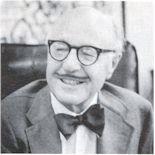
The news of the innovative Connecticut system spread quickly. Paul Galvin, of the Galvin Manufacturing Corp. offered Noble a position as Director of Research in 1940. In 1941 Teh cumbersomely named "Galvin Manufacturing Corp" reincorporated as Motorola.

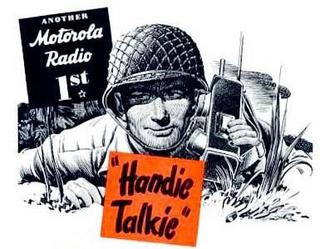
In 1943, Daniel E. Noble designed the first portable FM two-way radio for the U.S. Army Signal Corps. This radio weighed 35 pounds, had a range of 10 to 20 miles, and became known as a “walkie-talkie.” Initially it was known as the Handie-Talkie radio (sounds oddly like a dirty joke I once heard) The model SCR536 Handie-Talkie AM radio is used during World War II to link soldiers in the field to each other and to a central command. Its immediate millitary value cannot be over exaggerated.

He also had a heavy hand in the beginnings of many great Conecticut stations including WDRC, and WHUS. He also performed a series of experiments with high frequency broadcasting from W1XSL at 40.3 MHz. It was renamed W1XPW in early 1938.

More here: http://www.wdrcobg.com/noble1.html

Daniel E. Noble was born on October 4, 1901, in Naugatuck, Connecticut, received his B.S. degree in engineering from UCONN [go huskies] and attended MIT graduate student.
-There is a great Noble bio on the equally great www.ieee.com

Noble died on 16 February 1980, at the age of 78