I once had to tell a friend these two rules.
1. Do not date Carnys
2. Do not date people who could be carnys.
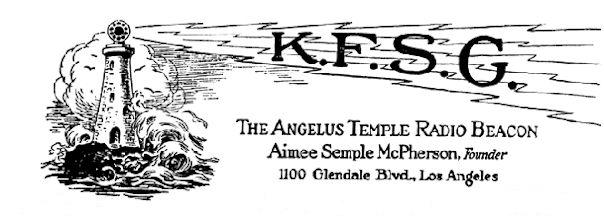
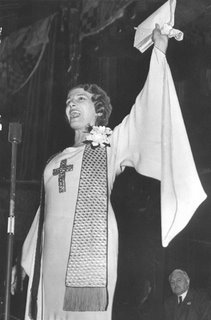
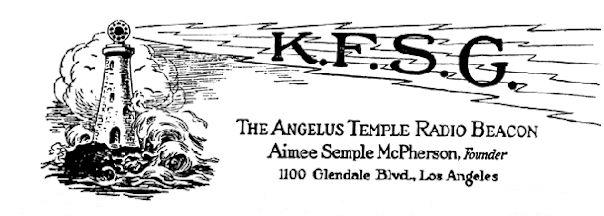
Radio has been home to many people who would otherwise been carnys. Hucksters, loonies, and a great assortment of wackos that just need attention. Aimee Semple McPherson could have been a carny. Instead she was one of the very first christian radio evangelists, and she founded the very first all religious radio station in the world.
Aimee was no ordinary evangelist. She was a charismatic freak of untold proportions. The radio made Aimee's voice one of the most recognizable of that era. Those who tuned to
KFSG (or dayshare
KRKD) to listen to her, heard her open with the same words each day: "
You thousands of people here, you in the orchestra, you in the first balcony, you in the second balcony, you crowds standing in the rear, you thousands listening in over the radio!" Her ego was a titanic thing of legend. Sister McPherson kept busy, working spread the word of Jesus as far and wide as she could. Besides the
KFSG broadcasts and the illustrated dramatic [these involved actual theatre] sermons performed onstage at Angelus Temple, she also syndicated some of her sermons, which were recorded and sent to various radio stations across the nation. A scenario played out on public access today.
But there are so many fervent christian radio evangelists on the radio. Why is she special? During the earliest years of
KFSG and the Angelus Temple, Aimee Semple McPherson's name had appeared on the front page of Los Angeles newspapers an average of 3 times a week. A similar amount of press coverage on Aimee had taken place in the New York Times and other large newspapers, between 1926 and 1937. Up until 1937, there had been about 45 lawsuits filed against Aimee and/or Angelus Temple. It was that year she cut her traveling back to a minimum and started her "no interview policy" with the newspapers. She was as well-known then as Elvis is today. She even cut back on speaking in tongues and faith-healings.
Without getting into the details of the lawsuits, (which are a vaudeville stage show of their own) I'll just start with the drugs. Amiee did a lot of drugs. She wasn't the first San Franciscan to do drugs, but she was the the best at it bar none. Heroin, cocaine, morphine, opium...Timothy Leary had nothing on this woman's idea of a heroic dose. Then there was the embezzling. I won't get into the dollar amounts but drugs are expensive. In 1925, the license for
KFSG was suspended by the Commerce Department (pre-FCC) for deviating from its assigned frequency. McPherson sent an angry telegram to then-Commerce Secretary Herbert Hoover ordering his "minions of Satan" to release her station at once. This woman was a certifiable nutbar.
Oh wait there's more..... there was a kiddnapping scandal.As McPherson later told it, she was kidnapped on Tuesday afternoon, May 26, and spirited away to a cabin where she was held prisoner. That evening, it was announced at Angelus Temple that Sister had gone for a swim, failed to return, and was presumed drowned. For the next few days, Los Angeles talked of little else fearing her dead. Thousands walked aimlessly on the Ocean Park Beach where Sister had last been seen, and an elaborate memorial service was held for McPherson on June 20, 1926.
Three days later At Agua Prieta (near Douglas, Arizona) on June 23, McPherson reappeared with a tale of having escaped from kidnappers across the desert on foot. The crowds that had mourned her loss prepared a lavish welcome home ceremony. But the law found several holes in her story.
Then witnesses came forward stating that they had seen McPherson with
KFSG engineer John Ormiston at various hotels over that period. Ormiston was married to a different woman! The accusations of infidelity were aimed mostly at the now twice-divorced Aimee. McPherson and her mother were charged with obstruction of justice. Aimee proceeded to have a series of nervous breakdowns, which continued until the charges were mercifully dropped. There had been many theories on what had happened. She had plastic surgery. She had an abortion. She was having an affair. She had an affair and plastic surgery. No one suggested in the news that she went to Tijuana and went on a 30-day drug and tequila bender. But that's what I think.
On September 27, 1944 she was found dead of an overdose of heroin and/or opium. Once again, rumors flew, this time conjecturing suicide. It may have been accidental. But the christian biographies of her skip this part entirely claiming she died of kidney failure. Fans of CSI will tell you that drug overdoses can cause kidney failure. It's akin to saying that President Kennedy died of lesions on the brain. McPherson's funeral took place on her fifty-fourth birthday, October 9, 1944. Ever the carny, her will insisted that she be buried with a working, wired telephone for... well who knows why.
While
KFSG wasn't the first religious station in the country, it didn't miss by much. The station was a true pioneer broadcaster, like the other L.A. radio stations that first went on the air in the tumultuous 1920s, radio's first big decade. During those "pioneering" days of radio,
KFSG set a standard for future Christian broadcasting, and cleared a path for the nearly 2000 religious radio stations on the air in the U.S. today to follow. It can be said, the lady dressed to impress.

 A message on wdet.org states that the station’s music programming “posed challenges for station fund raising and audience growth.” A euphemism for "the old people don't like it, and they have the money." At the NON-COMMvention 2004 in Philly the "graying of AAA" was a hot topic. An exodus of non-com AAA stations flipping to News/Talk has been predicted by more than one radio pundit. Ever the cynic, I question this as the right choice. Register for the Non-comvention 2006 here.







 While
While 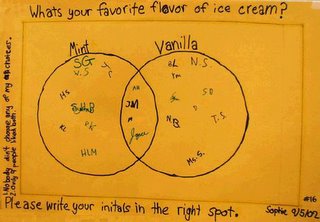 Radio formats are like Ice cream. AC is like vanilla. Lots of people love vanilla. And most people think it's ok. Almost nobody hates vanilla. Whereas a format like Americana is more like Chocolate marshmallow which is #15 off the list at only 1.3%.
 Posts
Posts