Monday, October 10, 2005

Radio Guam!


For no sensible reason, the U.S. continues to "own" islands in the pacific ocean. Certainly this has some millitary applications should we choose to obscess on communism and declare "millitary action" on another small asian country. But I am no war-monger. 'Cest la vi. I care only about radio.

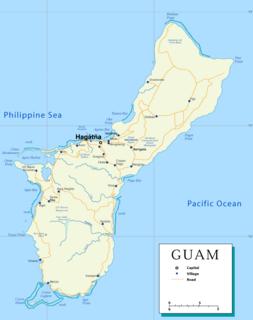
Guam is but one island in a short chain of islands about 1,300 miles east of The Phillipines. They have a great number of american amenties including american radio. They even have their very own public radio outlet: KPRG FM http://www.kprg.org/

They run out of the University of guam famed for... something. http://www.uog.edu/ [it's definitely scenic] They signed on only a few years ago, back on January 28, 1994. Since then they've become stunningly organized even starting up a press of KCRW-style membership cards good for members discounts at certain buisnesses. For Example:

• Present your KPRG membership card at Kaveh Kanes in the Ladera Towers and receive a loaded oatmeal cookie with any purchase. (I am not mocking them, I like oatmeal cookies)
Its as eclectic as you might expect a station on the edge of the world to be. Talk programs about star-gazing, the baroque hour, asian pop hits, and something called: "Prugraman I Halai Hai" I dont know what that means, but it sounds pretty local.

They run a lot of BBC, but that's very common as you get away from major cities abroad. In many areas of asia and africa shortwave radio is more common that FM or even AM. ...And BBC is on the shortwave and NPR is not. So there is a transition as these countries transition to a more western, more industial future... somebody usually figures out FM. NPR seems to move in right afterwards. It's decades before they'll put up with Fox News.

Friday, October 07, 2005

The short sad story of WASO

WASO opened its doors in early 1991 under the management of Robert Namer. He ran a mix of center-right and extremist conservative talk programs with shows by G. Gordon Liddy, Keith Rush, and of course Robert Namer himself. He archived his own radio shows here.

With a modest 250 watt AM signal and a viscous 25 watt PM power down they still reached the center of New Orleans, if not much else. But despite that valuable central coverage they never managed to appear in a single ratings book over the next decade. Things got weird in early 2002 when his own radio station (America First Communications) donated money at least 4 times to the election campaign for [R] Robert Namer to the House of Representatives. More info here. The AP wire, normally a source of excitement-free vanilla news took him down (clipped 6/29/2004) It was sketchy even for Louisiana.
"Conservative talk-show host Robert Namer used loans to his congressional campaign fund in 2002 to try to avoid paying $3 million owed the Federal Trade Commission, a federal court has ruled. Namer also illegally transferred money to companies owned by himself, his wife and their children for the same reason, the 5th U.S. Circuit Court of Appeals ruled Friday."

In 2003 Namer lost a legal judgement for throwing his campaign money in the same side of his wallet as his WASO money. By 2004 Mr. Namer was requesting waivers on the late fees for that judgement. In 2005 Namer lost his FCC license for non-payment of that judgement and the station was taken off the air by the Federal Trade Commission. Ouch here.

But there was a silver lining for WASO. On September 2nd 2005 authorities of the St. Tammany Parish seized the abandoned WASO studios and began broadcasting emergency information for the public benefit of hurricane Katrina survivors in the New Orleans area.

Wednesday, October 05, 2005

The First License Denial

Somebody had to be first.

As broadcasting began to develop, it became obvious to lawmakers that some type of regulation was needed to provide for orderly use of the airwaves. To fill this need, the FCC (Federal Communications Commission) was formed in 1934, the end result of the Communications Act of the same year. The FCC, now observing its 76th year, was officially established on June 19, 1934, when President Franklin Roosevelt signed the enabling legislation.

Within a year of that signature, the first license application was denied. It would have belonged to KGIX, Las Vegas for failure to complete its construction within the granted CP as required. It was deleted May 14 1935. These days that’s kind of an old story.

Eventually Owner J.M. Heaton re-files and eventually does bring KGIX on air. It becomes the first radio station in Las Vegas and starts broadcasting services devoted to the town's foundation and to its early days. The enterprise flops and shuts down.

Las Vegas didn’t have a radio station until Entrepreneur Max Kelch came in and bought KENO in 1940.

KGIX memories from the NEVADA STATE MUSEUM & HISTORICAL SOCIETY here: http://www.knpr.org/lvir/VonTobel.txt

I have read that there were 2 denials in 1934 but their dates seem to precede the formation of the FCC. These are somewhat spurious. These were:

WJEM, Tupelo, Licensee MS. Britt A. Rogers Jr. failed to renew construction permit; Deleted Oct. 2 1934.
WKFI, Greenville, MS. Licensee J. Pat Scully failed to apply for renewal of license; Deleted Oct. 3 1934.

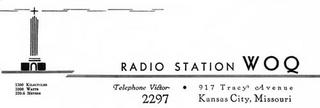
I have one outlier, a lone mention of a license denial possibly as early as 1931!!! I find it very suspicious but have little information in terms of validation for any of this regardless. Our O.O.P. is WOQ, Kansas City, MO. Licensee Western Radio Co. had their license deleted June 14, 1931 (or 1934) It’s facilities given to KFH, Wichita, KS. WOQ was Kansas City’s first commercial radio station.

Friday, September 30, 2005

Verified reception stamps

I wish this was still going on.

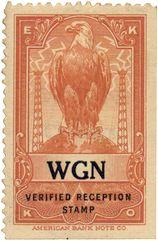
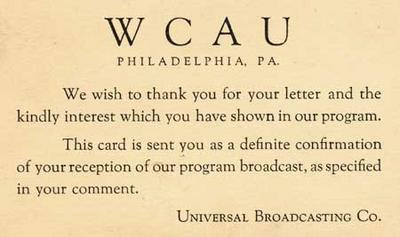
The basic idea is that you (the radio listener) confirm by mail that you have distantly received a radio station (usually shortwave and AM) . They would send you a verified reception stamp/letter/card etc. This was really, really cool. It fell out of favor because people who thought it was really really cool were not cool at all. [Ex people like me]

The process was very simple. An number of copmpanies made these for example: For only $1.75, the Ekko Company offered an album to collector sof new verified reception stamps. The album contains pages preprinted with an outline of each of the current available and a listing of broadcast station call letters with wavelengths. The inside cover had a nice little showing the locations of these stations. Spaces were left for new stations and your own notes. It was a few years before QSL cards and it's popularity may have been what probably led to QSL cards. Note: some hams still issue QSL cards today.

Interest in the hobby became so widespread that the February 1925 issue of Radio News featured the Ekko stamps on its cover.

http://uv201.com/Misc_Pages/letterheads_11.htm

I think Ekko was the first to offer the binder/stamp concept but the verified reception stamp fad was so popular that it prompted other companies to issue their own stamps or seals. Of course these did not fit into the Ekko binder. You had to buy their binder. Much like the uncompatible software problems of today, consumer confusion was an immediate problem.

Incredible set of pictures here:
http://uv201.com/framepage1.htm


www.dcrtv.com has pics here too: http://dcrtv.org/photo/mediawp5.html

and KLX here: http://community-2.webtv.net/N0NNK/KLZ560/

Thursday, September 29, 2005

Sixties Psychedelic Rock Radio

It was a the short second golden period of radio... blah blah FM... blah blah played full records, barely ands ads... yadda yadda. Everybody knows Fm was more free-form in the 70s. I wont get into it. I'll just go right to the good part.


WKMS 91.3 Myrray State Univeristy in Murray Kentucky. It's kinda near... well nothing. It's in the Marion-Carbondale market... near Paducah. [The only town with a funnier name than Paducah is Albuquerque.] I wanted to bring them up because they have a rock show dedicated strictly to 1970s rock with a keen emphasis on bad ass psychedelic bands. In a country with hundreds of jazz shows, blues shows, metal shows, and doo-wop shows this seemed a like a true nugget. (get it?) There is a world of classic rock stations out there playing these kind of cuts, but very few specialty programs on alternately formatted stations.

Rockin Saturday Night plays The Status Quo, Strawberry alarm Clock, Electric Prunes, Blue Magoos, Easy Beats, Mojo Men, Golliwogs.. Jeff Dunman is a man who knows his stuff. www.WKMS.com

The rest of the station isnt the slacker kingdom either. Beyond the edge, and The Indie connection are pretty rad little college rock programs running early sunday morning. Local celebrity John Griffin visits with us for two hours with Stateline Blues focusing on regional blues. Good stuff by artists like B.B. King, KoKo Taylor, Solomon Burke and Buddy Guy.