Friday, August 05, 2005

On The Road.

I will be on the road over the next two months.
Will be returning irregularly with more Arcane Radio Trivia. I'll be back daily upon my return. I promise.

If you need a radio fix try visiting these gentlemen:
http://radiosutton.blogspot.com/
http://futureofradio.typepad.com/
http://www.fybush.com/nerw.html
http://www.fybush.com/links.html

Thursday, August 04, 2005

NOT LICENSED FOR RADIO BROADCAST

In the 1920s the RIAA sued broadcasters to get them to STOP playing music. That's right kids. The record industry's "anti-airplay" platform lasted well into the 1930s.

We begin at the beginning... By the early 1920s, RCA was mass-producing commercial radios. While the radio didn't sound as good as the phonograph, it was still free. The recording industry was incensed and attempted to sue the radio stations to prevent them from playing recordings on the air. The first judges presented with this issue decided that if the radio station had purchased a copy of the recording they had a right to play it; since there was no law preventing it. It was a big set back for the RIAA.

In general, the 1930s were a tough period for the record industry. It was competing against the free content offered by radio stations in the great depression. The industry, dominated by 78 RPM records with a playing time of as little as three minutes per side, hit bottom around 1935. The juke box offered them something of a last minute reprieve. Yet the situation continued to be hampered in the 1940s by the wartime shortage of raw materials. The record industry concluded that they suffer when stations broadcast pre-recorded music. Their conclusion rested on two primary assumptions:
ONE - Consumers will not buy records when they could hear them on radio.
TWO - U.S. copyright law required that radio stations pay royalties to composers, lyricists, and publishers but not to record companies.

First, the New York Supreme Court ruled that if radio stations purchases a record, they were free to broadcast it ­ even when it bore a "Not Licensed for Broadcast" inscription. Displeased with this ruling, the dominant record firms pursued plans for obtaining fees from stations that broadcast pre-recorded music. To this day, they have still failed to get radio to pay the record labels for airplay.
In 1942, arguing that the new jukeboxs were putting live musicians out of work, the American Federation of Musicians declared a ban on recording. The AFM went on strike on August 1, 1942 in an attempt to get record companies to establish a fund for unemployed musicians. Most of the smaller and independent companies signed new contracts almost immediately; Decca signed a contract in September 1943, and the other major labels followed suit in November 1944.

Moving against the popular corporate wisdom, Capitol Records believed that broadcasting recordings would stimulate rather than harm sales. In search of airplay, Capitol promoted its records at radio stations. It was the first record firm to service free recordings to disk jockeys. it caused a dramatic increase in record sales. Unable to ignore Capitol's successful "pro-airplay" model, other dominant record firms followed suit.

Sounds familiar yet? The free music, doesn't sound as good as the original recorded media, but its popular, because its free. The then RIAA tries to sue the "offender" into submission...etc. A lots of bright folks see a parallel between the RIAAs recent desperate assaults on P2P platforms and their previous 1930s foolishness. I tend to agree. They've had a long history of resisting change, litigious zeal; and selective perception. Great article here.

Wednesday, August 03, 2005

The Incarceration Station

Angola Prison has had an illustrious but sad history in music. Many Blues artists were imprisoned here. Alan Lomax even recorded some of them while still serving their sentances: Bukka White, Harvey Knox, Charles Neville, Leadbelly, Jack Dupree, Robert Pete Williams, and many others. Several albums have been cut as well: Angola Prison Spirituals, Angola Prisoners Blues, Prison Worksongs and others.

KLSP is the only FCC licensed radio station to operate from within a prison by inmate DJs. KLSP 91.7 Algola, Louisiana is known as the "Incarceration Station." It operates at 100 watts and reaches approximately 6,000 people including staff, inmates, visitors and parts of the surrounding community. They signed on August 12, 1986.
Site here: http://www.corrections.state.la.us/lsp/KLSP.htm

Initially KLSP was envisioned as a emergency communication system. The Prison officials wanted to communicate to whole the inmate population simultaneously. An FM radio station appeared to be the right answer. The implementation was a little different. The Angola Education Foundation arranged for inmates to become DJ's and to entertain the masses with gospel, jazz, blues, rock-n-roll, country, and oldies.

But the original purpose worked in later emergencies. During the flood of 1997, Warden Burl Cain broadcast nightly over KLSP. The evacuation of over 3,000 inmates occurred without incident or injury.

I am told that the prison administration is actively seeking avenues to enhance capabilities of KLSP-97.1 FM. Thsi probably means "We want to make money."

Tuesday, August 02, 2005

Locally Originating Progamming

I dislike non-commercial stations that run exclusively satillite fed syndicated programming. The worst offender in this catagory is the religious broadcaster. (Fybush calls these satcasters) My main objection to is not to the content. It's the source of the content to which I object.

follow me on this detour:
The radio spectrum, like any physical property, or natural resource is finite. Each city can only contain so many broadcasters, so a government body exists to manage the space, the FCC. It's no different from your town council deciding who gets to develop the waterfront property. The point being; if the radio band is the property of a community, then content on the radio that originates from outside the community is, in a sense... stolen from them.

We all know perfectly well that many religious stations receive all programming via satillite. They then time-shift this programming and rebroadcast to meet some obtuse, nominal and ultimately impotent local programming requirement. Let me stop right here and point out that not all religious broadcasters are like this. Right near me is WNAP-AM 1110 who runs almost entirely local programming. http://wnap1110am.com/ It's a fine station who serves Norristown and the surrounding community just fine.

By comparison WKDN 106.9 Camden runs zero local programming. http://www.familyradio.com/index.htm

That RF belongs to the Camden Philadelphia Area, yet zero of their programming content originates locally. The FCC would tell you that somehow they serve our community. I would debate that strongly. That same signal could belong to any civic, religious or community group and serve Philadelphia more fully.

Out of fairness let me examine my local NPR affiliate: WHYY 90.9 FM Philadelphia, PA Look at their schedule Monday thru Friday: http://www.whyy.org

35 hours of BBC between the overnights, the news hour and the world

31 hours of NPR nationally syndicated programming from talk of the nation, morning edition, all things considered, News and Notes, Creators at Carnagie... etc

6 hours of Here and now & Sound Print from MPR

5 hours of Marketplace from American Public Media

1 hour of This American Live from Public Radio International

In the end, only these local programs run Monday thru Friday. Out of a total possible 120 hours 16 originate locally. That's about 14%. It's not a lot. but it's more thant zero. These local shows are:

5 hours of Radio times

10 hours of Fresh air (counting the afternoon rebrocast)

1 hour of Voices in the family

That being said, the WHYY weekends are a smorgasbord of local shows.

Monday, August 01, 2005

I have a radio in my tooth

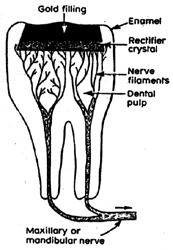
There are some rare cases where the fillings in peoples molars got radio reception. It's possible for any non-linear electrical circuit can demodulate AM radio signals. Slightly corroded metal fillings, or even an electrolytic connection could potentially do i. It's not that different from a crystal radio set. I repeat, it is possible for your tooth fillings function this way. It's just highly unlikely. If you were in close proximity to the transmitter and all the planets were aligned... There have been reports of this phenomenon since the early 20s. The names below have been changed because I keep bad notes...

John Smith of Evanston IL, lost a front tooth in 1961, he was fitted with a cap that was attached to the tooth stump with brass wire. Thereafter he began hearing music in his head, generally popular tunes of the day, usually while he was outdoors. He described the music as soft but distinct. He never heard an announcer's voice or commercials and was unable to identify what radio station, if any, he was hearing. After a year or two of this a new dentist put in a cap without a wire and the tunes stopped. BELIEVABILITY: 3 of 10

JANE SMITH also of Suburban Chicago, says in 1947, while she was riding a train from Cleveland to Rhode Island she heard radio in her head. The experience lasted maybe 10 minutes. She couldn't tell what station she was listening to but recalls hearing commercials and an announcer's voice. She had recent silver tooth fillings. BELIEVABILITY: 2 of 10

WFIU 103.7 Bloomington, IL
Due to the location of WFIU’s 100 foot transmission tower in the center of campus and its impressive 75,000 watt signal strength its RF "wake" became notorious. Students who lived in the surrounding dormitories reported they could pick up WFIU on their dental fillings, eyeglasses, electric shavers, etc. People claimed they could hear WFIU on their stereo speakers, even when their stereo was off.  More here. BELIEVABILITY: 8 of 10 

Today the toothradio actually exists. It was "invented" by a man named Andrija Puharich. He also was visited by space aliens and regularly ingested Psilocybin mushrooms and hung out with timothy Leary. He is not a complete loon, most of his other inventions relate to hearing aids.

The invention comprises an element applied to a viable tooth, for receiving RF signals and a transducer and a receiving element. It uses live nerve endings of the tooth for converting the electromagnetic signals to electric signals at audio frequency. It has US Patent 2995633. He made numerous improvements to the design until it was as popular among Russian spies as their trusty micro-dot camera.

In my world, things like these are called celibacy devices.