Friday, July 29, 2005

Public Radio of Micronesia

KRNM is a Public Radio station located on the campus of Northern Marianas College (NMC). They broadcast at from two physical locations one at their studios on 88.1 FM on the campus of NMC. Then on a translator at 89.1 serving Mt. Tapochao and the North eastern areas of the island. The volunteers arent all that different from what you'd get in Paducah. On Monday nights at 9:00 PM they have a blues program. Tuesday nights the Saipan hisghschool performs radio dramas. Saturday nights they read stories and plays from around the world. They even have a Country music program on saturday nights.

to me this is awesome.
http://www.krnm.org/about.htm

Thursday, July 28, 2005

BUSTED FOR PAYOLA

I try to avoid current events, but this really got me going (since I am an ex-promo man myself). The way the gears have turned in the record industry hasn't changed in half a century. This most recent Sony scandal isnt going to change a thing. There will be a few new sacrifical lambs.Alan Freed was driven out of the buisness. Sony will probably make a charitable contribution. The Radio staitons will probably get a tersely worded warning.

If you hadn't heard... Sony got busted for Payola.
Below are quotes from emails naming radio stations they bribed for airplay.
I quote some great lines below. but the full text from Spitzer is here:
http://www.oag.state.ny.us/press/2005/jul/payola2.pdf

In discussing a bribe given to a radio programmer in Buffalo, one promotion executive at Sony BMG's Epic Records wrote to a colleague at Epic: "Two weeks ago, it cost us over 4000.00 to get Franz [Ferdinand] on WKSE. That is what the four trips to Miami and hotel cost . . . At the end of the day, [David] Universal added GC [Good Charlotte] and Gretchen Wilson and hit Alex up for another grand and they settled for $750.00. So almost $5000.00 in two weeks for overnight airplay. He told me that Tommy really wanted him to do it so he cut the deal."

Another Epic employee who was trying to promote the group Audioslave to a Clear Channel programmer asked in an email: "WHAT DO I HAVE TO DO TO GET AUDIOSLAVE ON WKSS THIS WEEK?!!? Whatever you can dream up, I can make it happen."

A promotion employee unhappy with the times assigned for spins of the song "I Drove All Night" by Celine Dion wrote this internal email: "OK, HERE IT IS IN BLACK AND WHITE AND IT'S SERIOUS: IF A RADIO STATION GOT A FLYAWAY TO A CELINE [DION] SHOW IN LAS VEGAS FOR THE ADD, AND THEY'RE PLAYING THE SONG ALL IN OVERNIGHTS, THEY ARE NOT GETTING THE FLYAWAY. PLEASE FIX THE OVERNIGHT ROTATIONS IMMEDIATELY."

Wednesday, July 27, 2005

K, W & the mighty Missisippi

In the 1800s broadcasters adopted call signs to aid in signaling. This practice continued when ships began to use radio. [popularized by the sinking of the titanic] Initially brodcasters determined their own calls. This led to duplication and confusion.

In 1884 the first effort to standardize this occurred. The head of the Federal Bureau of Navigation, (FBN) Eugene T. Chamberlain, exorcised a new vaguely worded statute and assigned marine-radio call letters. His previous career as Ships on the Atlantic and gulf coasts were assigned calls beginning with K, and those on the Pacific coast and Great Lakes were assigned calls beginning with W. It is unknown why he chose K and W.

In 1906 Berlin International Wireless Telegraph Convention (BIWTC) declared that all ship and shore stations should have unique call signs consisting of three letters. The U.S. did not ratify the BIWT convention until 1912. (why are we always behind Europe?) That year Congress empowered the FBN to license land stations in addition to the marine stations. Official documents issued in 1913 confirmed the practice of assigning W calls to stations in the west and K calls to stations in the east.

The following year Congressimproved the system slightly deciding that the Pacific coast would get W for ships and K for land stations, the Atlantic and gulf coasts would get K for ships and W for land stations. This made it more simple to distinguish a marine broadcast from a land broadcast.

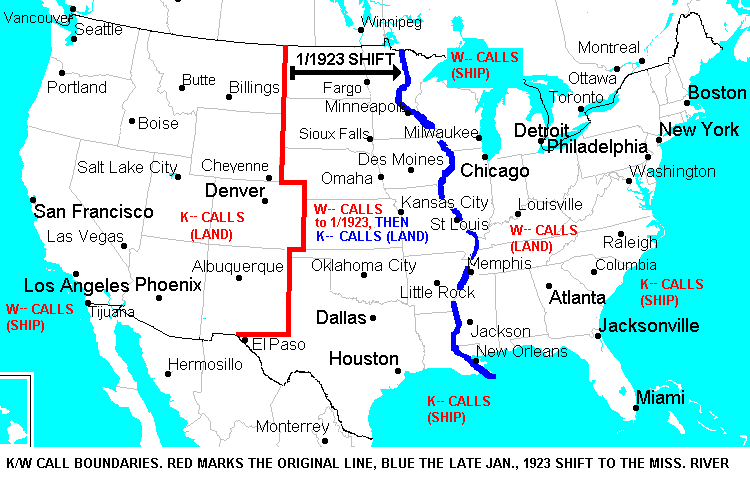
It was not until 1923 that the missisippi became the dividing line. Prior to that Texas as a gulf coast state had W's! The dividing line started at El Paso and worked its way east the then north.
see map: http://earlyradiohistory.us/kwbigmap.gif

There are many exceptions to the K&W rules even today. Below are some contemporary examples. These are all considered "heritage" call letters and they are highly valued.
KYW-AM 1060 Philadelphia, PA ...the K furthest to the east
WIL-AM 1430 St. Louis, MO
WOAI-AM 1200 San Antonio, TX ...the furthest W to the west.
WOI 90.1 Des Moines, IA

Exceptions along the border are commonplace as the calls are assigned by city of license and not the location of the transmitter. Minneapolis , Memphis, New Orleans and other markets straddle the line and each contain multiple exceptions. A simple explaination here:
http://www.dxing.com/callsign.htm

For all of his trouble-making, eventually the Navy named a ship after Mr. Chamberlain. It is a Liberty Model.

Tuesday, July 26, 2005

Everybody Klezmer!

Everyone likes klezmer. They just don't know it yet.

In the 1930's there used to be dozens of Yiddish radio stations and hundreds more individual radio programs. There were 30 just in new York city! Not all were playing Klezmer but you get the idea. Today there are only a few in the whole world. Many only squeeze as time leased programming. Nothing wrong with time leased programming mind you. It's just not exactly the bee's knee's as time slots go usually. Below is a small selection of these programs

WUNR 1600 AM Boston, MA
"The Yiddish Voice"
Runs a weekly, hour-long Yiddish-language radio show serving Boston's Yiddish-speaking community since 1994.

WNWR AM 1540 Philadelphia, PA
"The Barry Reisman Show"

...On the air Monday - Friday from 3-4 weekday afternoons. Reisman's blend of klezmer, Yiddish, and Israeli music along with interviews and listener phone calls have made his program a fixture in the Philadelphia radio market since 1965.

WMRD 1150 AM Middletown, CT/WLIS-AM 1420 Old Saybrook, CT
"N'Shoma"

A music program focused on eclectic and contemporary Klezmer & Jewish music. They announce listings of activities from local synagogues and organizations

WMNF 88.5 Tampa, FL
"Sunday Simcha"
Music, local announcements, Dvar Torah, interviews, etc. The audience has grown over the years and includes many non-Jews as well. The music is a mix of Klezmer, Chassidic, Israeli, Yiddish, Ladino, Mizrachi and more.

KEOS 89.1 College Station, TX
"Rejuvenating Heritage"

A weekly radio program exploring all types of Jewish music. It features a mix of Israeli pop/rock, Yiddish, Klezmer, as well as other Jewish inspired music.

And don't forget this...
THE YIDDISH RADIO PROJECT
http://www.yiddishradioproject.org/
http://www.yiddishculture.org/radio/
Damn that was a good CD, a great reason to donate to NPR.

Monday, July 25, 2005

Markets Merging...

Arbitron releases it's new market ratings and definitions twice a year; each spring and each fall. The biggest shake up I remember in recent years was been the deletion of the Westchester market. Typically market changes involve the addition or deletion of far more tertiary markets. But in the not so distant past Arbitron has changed major markets. Once Dallas and Ft. Worth were separate market areas. Obviously, this was no small change. Even today their downtown areas are 30 miles apart. Can you imagine the chaos if they merged Baltimore and Washington D.C.? That's only 35 miles. It is equally possible. I examine this change focusing on one particular station was went from the top of its game to an unrated station because of this market change.

KBOX-AM 1480 was the first all country 24-hour radio station in the Dallas Metro. This was historic. Group One Broadcasting of Texas acquired KBOX from Balaban Broadcasting in 1967 for $2 million dollars. KPCN-730 AM was the first country station in the area, starting in 1962, but broadcasted during the daytime only. KBOX quickly became the ratings leader for country music in Dallas. In its first ratings book, they moved from a 10.0 share Q3 1966 to a 12.1 share in Q1 1967!

KBOX-AM enjoyed six years of solid ratings, posting a high of 14.4 in the Q3 1967 book. In 1972 WBAP-AM began giving them stiff competition as a country-formatted 50k watt powerhouse. KBOX's ratings started to slowly sliding as a result. The Clear Channel owned WBAP was trying to chip away at their audience and it was working.

In the year 1973, the Arbitron markets for Dallas and Fort Worth were combined into one book, to reflect the merging of the two cities into one metropolitan area. KBOX, like other smaller stations, was hurt by this redefinition. KBOX did not even appear in the new ratings book. WBAP-AM became the clear country winner at that point, as KBOX barely reached the Ft. Worth half of the newly defined market.

In 1976 Group One applied for a nighttime power increase from 500 watts to 1,000 watts. The FCC approved it. This gave them a somewhat less marginal signal. It's probably what allowed them to struggle into the 1980's providing a decidedly more local service to the Dallas area. But by 1980 FM radio was growing in dominance and their ability to compete with a music format was waining.

on November 14, 1982 the KBOX call letters were dropped by Group One. KBOX-AM became KMEZ-AM and switched from its country format to a simulcast of the easy listening format of sister station KMEZ-FM. These days 1480 AM is occupied by KNIT-AM A Salem Media property running a decidedly more mundane gospel format.

You can hear a 2:00 .WMA of classic KBOX news from 1958 here:
http://www.michaelspears.com/kbox56k.wma
Great thanks to Michael Spears Entertainment just for existing.

great KBOX-AM history here:
http://www.knus99.com/kbox1480pt2.html