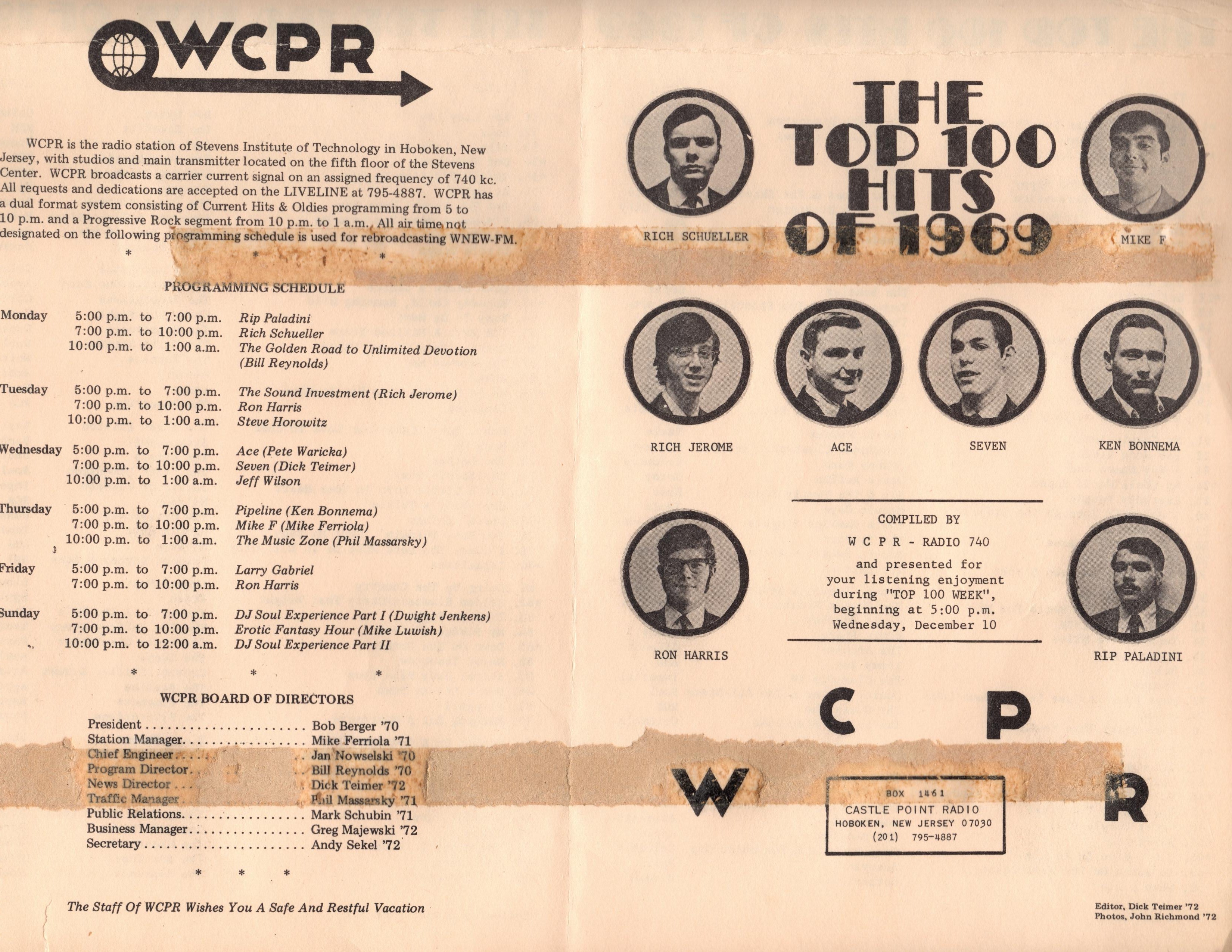
I've come to believe that some people were almost famous, maybe even meant to be famous. These people had some kind of inertia that the rest of us lack and they veered off of that trajectory at the last second, perhaps for reasons only they understand. After the sixth or seventh time I saw his name I tracked down Mr. Harris and he was very giving of his time to answer my questions ...even the ones I didn't know to ask. What followed where tales of creatively liberated equipment, FCC violations, rock stars, Russian profanity, and an unexpected intersection with Rush Limbaugh...
He had so many stories I'm just going to go ahead and call this "Part 1." I know I'll be back for more questions and answers.
JF - WCPR was the student-run radio station at Stevens Institute of Technology, in Hoboken, NJ. How did you end up becoming the music director?
RH: Well, I started my freshman year at Stevens on Sept. 14, 1969. WCPR was looking for DJs, and I became active both as a DJ and doing some production there. When the Music Director position opened up I volunteered for it.
JF: WCPR was a carrier current station at that time.
RH: WCPR broadcast via carrier current on 740 kHz for much of its existence. Carrier current transmitters worked by coupling into each building's power lines, which served as weak antennas. Evidently not weak enough, because it turned out that the 740 kHz transmitter in one dorm could cause interference, or beat's against another one in a nearby dorm. So WCPR decided to change some to 750 kHz. In those days there were very few (if any) AM radios that could show the exact tuning like today's digital ones, so the frequency difference was pretty much transparent to the dorm listeners. Just for fun, we started calling it "The Sporty 7-40 and the Nifty 7-50" and the slogan stuck

JF: Is there any truth to the story about WCPR increasing it's range using the SS Stevens, the ship the college bought to use as a floating dormitory?
RH:That was a year or two before I got there. The ship had been built in 1944 as a military attack transport, the USS Dauphin. After World War II it was sold and converted into a cruise ship, the SS Exochorda. Stevens bought it in 1967 to use as a floating dormitory and renamed it the SS Stevens. The WCPR engineers installed a carrier current transmitter aboard the ship (the metal hull basically blocked all the commercial radio stations, making our signal the only one that could be picked up in the cabins).
It turned out the AC power circuit they used fed the dorm cabins, and also the string of lights that spanned the length of the ship, on typically tall masts. Evidently that string of lights acted as a terrific antenna, and the station could be heard all over the eastern seaboard and beyond. Whether that was deliberate or accidental is not known (I mean, we were a science and engineering school!). Things were great until the Dean of Students received a letter from the FCC informing him that it was a very illegal situation! That was the end of our semi-national broadcasting experience!
A few years later, they installed a low power FM transmitter on top of the Stevens Library, pretty much in the center of the campus dorms. I don't know the story about why it was taken down, but I suspect the same government agency might have become involved.
JFK There was also a WCPR pirate radio station in Brooklyn in 1976. Was the WCPR staff involved with that at all?
I think I heard something about it, but it had no connection with us. Stevens Tech was on what's known as Castle Point in Hoboken, NJ, hence Castle Point Radio. It's literally a stones throw from the Hudson River, across from West 4th St. in Manhattan. The original call letters were WSRN ("Stevens Radio Network"), but they were changed in the 1960s.
[Confirmed with multiple references: Radio Daily-Television Daily refers to the station as WSRN in 1957, the Stevens Indicator in 1962, and Billboard as late as 1966.]
JF. Back in the early 1970s you were reporting airplay to the Billboard "Campus Programming Aids." What was that like and how did it work?
RH: As Music Director, I wanted to increase our record company service, so, being a 15-minute PATH/subway ride from the Billboard offices, I became friends with Bob Glassenburg, the College Radio editor for Billboard. I was also sending out our playlist every other week to every record company I could find, and I had a talented classmate drawing a radio-related cartoon on each one to help it stand out . I also got to know the major record company promotion guys in NYC, and those contacts and connections increased the number of promo records we received [free!] to something like 50+ singles and 20+ albums each month (I don't remember the exact number, but it was probably higher than that). The promo guys at the record companies would call me to hype their current product. All in all, it was a really successful project and I was respected at the station and by the record companies. A side benefit was getting comp tickets to shows at the Fillmore East and other local venues!
Stevens being a science and engineering school, our Top 40 chart was called "The WCPR Slide Rule Survey." Yeah, I know it's a groaner, but back then every student was required to have a slide rule!!
JF: You won a "Campus Humor" contest with some kind of with a satirical production about the kidnapping of a college Dean. Can you tell me about that and does that audio still exist?
RH: The Gillette Company, makers of men's shaving items, released a new product, a hairspray for men called The Dry Look. One of their promotion ideas was a national college campus push. They went to some 30 or 40 colleges and offered the student radio stations a chance to participate in a contest. Each station would have several people or teams create different audio vignettes about some aspect of college life. The vignettes would be played on the station, and there would be a vote by the students for their favorite vignette. When they voted, they'd also be given a can of The Dry Look. The winning creative producer/team received a $100 prize.
Then, the first place vignette from each school would be submitted for judging by several professional broadcasters, as well as the College Radio editor at Billboard. The judges included NBC TV and radio drama critic, Leonard Probst, and kids' show host comedian Soupy Sales.
I wrote a script for "The Kidnap" a satirical take on the unrest and protests taking place at campuses across America. I enlisted our Chief Engineer, Mike Ferriola, to co-produce it with me, and we each did some of the voices, and utilized some station members and even one of the campus security officers for additional voices. I added some sound effects and music, and it was voted #1 by the students at Stevens.
Now, I knew we were up against much bigger schools (I think Dartmouth and Harvard were among them), so I didn't have very high expectations. As all of the local winning creations were being judged by the professional panel, I got a call from my friend, Bob Glassenburg at Billboard, saying "Ron, you S.O.B.! I'm not supposed to tell you this, but no one even came close to what you created! Just please act surprised when they contact you!" Both Mike and I couldn't believe it, but it was true! Our prize was $1,500 and an all-expense-paid week's trip to New York City, plus $1,000 for WCPR.
Of course, since we both lived on campus right across the river from NYC, the "trip" consisted of a few subway tokens, but Gillette did put us up in the Loew's Midtown Motor Inn in Times Square, and set up meetings with ad agencies and radio and TV stations! We also were guests on the Joe Franklin radio show, and Joe played our winning entry on the air on WOR during the program! It was a truly exhilarating and heady experience for us both!
[I have heard "The Kidnap" audio and can confirm what Ron and Mike did with 1/4" tape and cart machines is amazing. I have posted it on Youtube HERE]
JF: In 1973 you moved to Illinois to attend Southern Illinois U. What drove that change?
By the middle of my junior year at Stevens I realized my heart wasn't in computer science or electrical engineering, but rather in radio broadcasting and production. During the first semester of my junior year I was spending all my time at WCPR, and went to something like two classes and took one exam, an open-book test on which I got a grade of 24 (out of 100). Then, as the semester was drawing to a close, around the beginning of December, I was summoned to the Dean's office. The conversation started out, "Ron, I know you're not happy here at Stevens...", and my reply was "Dean, I LOVE it here at Tech, and especially WCPR!" But the decision had been made: I should transfer to another school. As the semester was virtually over, I asked the Dean if I could get grades of "W" for "Withdrew" instead of what I should have gotten, "WF" for Withdrew-Failed.WF grades for every class that semester would have made it tough to transfer to any college, and no school meant I'd lose my deferment from military service. This being the time of the war in Vietnam, I really needed that deferment. The Dean agreed to bend the rules for me, and so my grades that semester were all "W"s.
I went to the Stevens Library and looked at the college catalogs on file (Stevens was a very hard school, and I wasn't the first to need to look for an alternative). The one that stood out to me was Southern Illinois University-Edwardsville, a recently-opened satellite campus from the main one in Carbondale, IL. They had a brand new 50,000 watt public radio station, WSIE-FM, and that clinched the deal for me! Their classes started on January 3rd, 1972, giving me about three weeks to apply to transfer there. I was accepted right before Christmas, 1971, and so on New Year's Day 1972, I loaded up my car and drove to Illinois without having any idea what the school and station would be like. I graduated a year and a half later with a Bachelor of Science degree in Mass Communications/Broadcasting.
JF: You were also a DJ at WSIE-FM. That's mostly a Jazz station today, what was that like in your tenure?
In those days, WSIE was a mix of pop, classical and opera. I was working on the air on Saturdays and Sundays doing a show called, "Swing Easy" featuring light pop and big band jazz, as well as the show "Masters of the Opera" (no easy task, as I knew nothing about opera nor how to pronounce most of the names!). I was also doing production at the station, and was a teacher's helper in the Radio Production courses. There were some talented people there. Two who had graduated before I got to the school were Peter Maer, who went on to become a reporter for the Mutual Broadcasting System, and Bill Plaschke, senior sports columnist for the Los Angeles Times. I also worked part time at a country music station, WGNU in Granite City, IL (part of the St. Louis market), and I spent a full semester earning academic credit as an intern at KIRL radio in St. Charles/St. Louis.
JF. You started in commercial radio in 1973 at KGMO, did that overlap with WSIE or was that after graduation?
I graduated in June, 1973, and sent out about 10 aircheck audition tapes to stations around the Southeast Missouri and Southern Illinois areas. KGMO AM/FM was the first station to reply, and so I started on-air doing 8:00 PM to 1:00 AM in mid-August. I was on KGMO-FM only, as the AM was a daytimer. DJs on the AM/FM simulcast were paid $100 a week salary, but those of us on only FM started out as hourly employees for much less money. Well, a month later I came down with mononucleosis, and had to recuperate for a few weeks. KGMO had a reputation for not wanting to wait for a sick DJ to return, and I fully expected to be let go. To my surprise, the station manager called me and said they liked my work so much they were moving me to afternoon drive on both AM and FM, and even more surprising, they made it effective for even the time I was sick, paying me the $100 weekly salary for the month I was out! Interesting fact: the DJ who was doing afternoon drive and had left before I got there was a guy whose air name was "Rusty Sharpe" and he was pretty good. I guess he might have gotten his job at least in part because his father was part owner of the station, one Mr. Limbaugh. And "Rusty Sharpe" was his son, Rush Limbaugh, who would go on to have the number one conservative network radio talk show for many years!
JF: What was KGMO like 40 years ago? I think it was an AM/FM simulcast at that time.
The station was in a building with a metal Quonset hut-type add-on as the studio. The air conditioning broke down fairly often, and it would get extremely hot in there. Of course, the service company deal was a trade out where KGMO gave them lots of free advertising in lieu of having to pay them for repairs, so when the AC died, we were way down on their priority list! I did many shows in that blazing inferno wearing just my briefs!
JF: By the mid 70s you seem to have mostly left on-air roles and become primarily a production engineer. Was that a difficult change?
Well, I had always been interested in radio station jingles, and had collected a large number of them from stations all over the U.S. and the world. The major companies that produced jingles were in Dallas, TX (thanks to favorable union agreements with the singers and players). I was friends with the two biggest and best known jingle "collectors" who ended up working for the two biggest jingle production companies. Jon Wolfert was at PAMS Productions, and Ken Justiss was at TM Productions, both in Dallas. Ken was looking for someone to work with him in production, and had heard a lot of my KGMO production work. He offered me a job at TM, and I didn't hesitate a second! Even though I had pretty much experience using only basic mono and stereo equipment, I was determined to become proficient at using the 16-trck multi-track recorders and other studio gear. Being the new "hotshot kid" it took me a while to gain the confidence and respect of the other engineers at TM, but I did. And although TM and PAMS were competitors, Jon, Ken and I stayed great friends, and I still stay in touch with them 50 years later!
 |
| Bob Glassenburg's Billboard column - 1973 (excerpt) |
JF: You moved to Los Angeles and went on to be a production engineer at Westwood One radio Networks for decades.
Yes! In 1981, I went for an interview with Norm Pattiz, founder and CEO of the Westwood One Radio Networks. I started there as a production engineer in April, 1981, and would stay there for the next 31 years! In that time, I produced some of Westwood One's top radio programs, like Casey Kasem's countdown shows; Scott Shannon' Rockin' America Top 30 Countdown and Randy Jackson's Hit List shows (Randy, in addition to being a top music producer and former member of Journey, was one of the original judges on American Idol); and I was Technical Director and board op for many live concert broadcasts, as well as "Radio USA For Africa" and a 90-minute Larry King interview special with then-President Bill Clinton in our studio! I assembled a 54-hour show called "The Rock Years, Portrait of an Era," a history of album rock! One of the first live concerts I board-op'ed was the Moscow Music Peace Festival, a major production involving several satellite hand-offs for a concert coming live from Russia. It was going well until an American band front man decided to teach the Russian crowd how to say "F__K!" in English! This was before we had digital delays to cut out obscenities, so I had to try to anticipate the word and mute the feed to try to avoid having Russian youth gleefully screaming you-know-what on a high-profile broadcast all across America!
Westwood One merged with another radio network in 2011. One of the stated goals was to combine the best people from each company for the new incarnation. But, the day the merger was approved by the Justice Department, the powers that be laid off something like 98% of the Westwood One employees! I lasted another few months, and then on February 6, 2012, it was my turn. I was 60 years old, and after 31 years of doing what I loved and more, often in 14-hour days, 6 or 7 days a week, I was ready to retire! The irony of it was that they ended up having to hire three people to take over all the work I'd been doing!
As I write this almost 15 years later, I really can't complain at all. I've had an incredible life, from my DJ days to working with presidents and rock stars, as well as learning and developing new skills, doing things I never imagined I would be able to learn and do. I'm still one of the only Chief Engineers who can't solder worth a damn, but hey, there are people for that! For a kid from West Caldwell, New Jersey, who flunked out of his first college, I've done pretty darn well!


 Posts
Posts