Showing posts with label WWV. Show all posts

Tuesday, April 04, 2006

Sunspots and your radio

Seeing as this is a quickly impending reception problem I thought I'd talk about sunspots. It's easy to get lost in the science behind radio wave propagation, (I get lost myself) but there are a few simple rules of thumb you can use to help understand the basics.

...A little history first: Back in 1928 a physicist named Karl Jansky was working on this new fangled technology called radio telephony for Bell labs. At the time, Trans-Atlantic telephone connections (via radio) suffered from interference caused by several things, one of which was a mysterious phenomenon called "magnetic storms." These could disrupt service for days. Nobody knew what caused it, or when or how.

Jansky was not very experienced in radio but took his task seriously. By 1931 Jansky was making regular observations of radio static at a frequency of 20.5 MHz. He identified three basic types of static:
1. Nearby thunderstorms

2. Distant thunderstorms

3. A faint steady hiss of unknown origin.

Jansky spent over a year investigating the third type of static. It rose and fell once a day, leading Jansky to think at first that he was seeing radiation from the Sun. Some of the radio static he observed came from a fixed point in the sky, and it moved! Ultimately he figured out that the source of the cosmic radio noise was our galaxy itself.

So here's where this relates to your radio. You are all aware that AM radio waves (distant ones at least) bounce off the atmosphere as part of their normal propagation. These layers are ionised by radiation from the sun. About every 10 years the sun enters the "solar maximum" a part of its normal cycle when solar activity is high. This increases its output of radiation and a specific layer of our atmosphere, the ionosphere becomes very dense. The good news is that many radio waves from space bounce off and do not cause us interference. The bad news is terrestrial radio stations and other sources of static are trapped inside the ionosphere and cause a great deal of interference. [janskys observations could never have occurred during the maximum]

During a solar maximum the number of sun spots is high, and during a solar minimum the number of sun spots is low. We are entering a solar maximum. This is measured in units of solar flux. Solar Flux is related to the number of sunspots, and affects which frequencies of noise are generally audible. Solar Flux doesn't generally go below about 70; if it's below 100, lower frequencies will work better than higher frequencies. If it's above 150, higher radio frequencies will open.

Then there is the K-index. It's released every three hours by NOAA, and it varies between 0 and 9. If the K-index is 0 or 1 for a few periods in a row, you can expect to hear stations that are normally weak or in someway problematic at somewhat stronger levels. You may hear a few stations that are normally inaudible at weak levels. If the K-index is between 2 and 4, conditions are pretty much normal. If the K-index is 5 or above, there's a geomagnetic storm. The higher the K-index, the more disturbed conditions are. You can check it here. You can also get them on WWV. They broadcast them at 18 minutes past every hour here.

Friday, March 03, 2006

NIST Radio

(NIST) The National Institute of Science & Technology is a federal technology agency that works with American business firms and industry to develop and apply technology, measurements, and standards. Sound vague right? In a nutshell, they measure stuff, and decide how stuff should be measured. Sound kind of small when I describe it like that, but when you realize that they determine standards for a wide range of things such as: the calibration of blood glucometers, standards for police body armor, DNA testing accuracy, proper radiation exposure levels, and even the time stamps of all NASDAQ stock transactions.

What they are most known for is the 1.5 billion times a day that NIST’s Internet Time Service sets and synchronizes computer clocks other networked time-keeping devices. Without which the Internet could not function. i.e This blog would not exist. These three stations are in the two bands the FCC has allocated for "Standard Frequency and time signal" They maintain the standard for frequency and time intervals, setting the official time for the entire United States. On the side they have a program of research and service activities in time and frequency metrology. They are accurate to one millisecond if one corrects for the distance from the station.
In 1923 NIST launched WWV. A sister station, WWVH, was established in 1948 in Hawaii. In 1956, they launched a low-frequency station, WWVB. It offers greater accuracy than the other two it's signal covers most of the North American continent. Their signals include UTC time in both voice and coded form; time intervals and audio tones; information about Atlantic or Pacific storms; geophysical alert data related to radio propagation conditions; and other public service announcements. More here. They also operate a few radio stations:

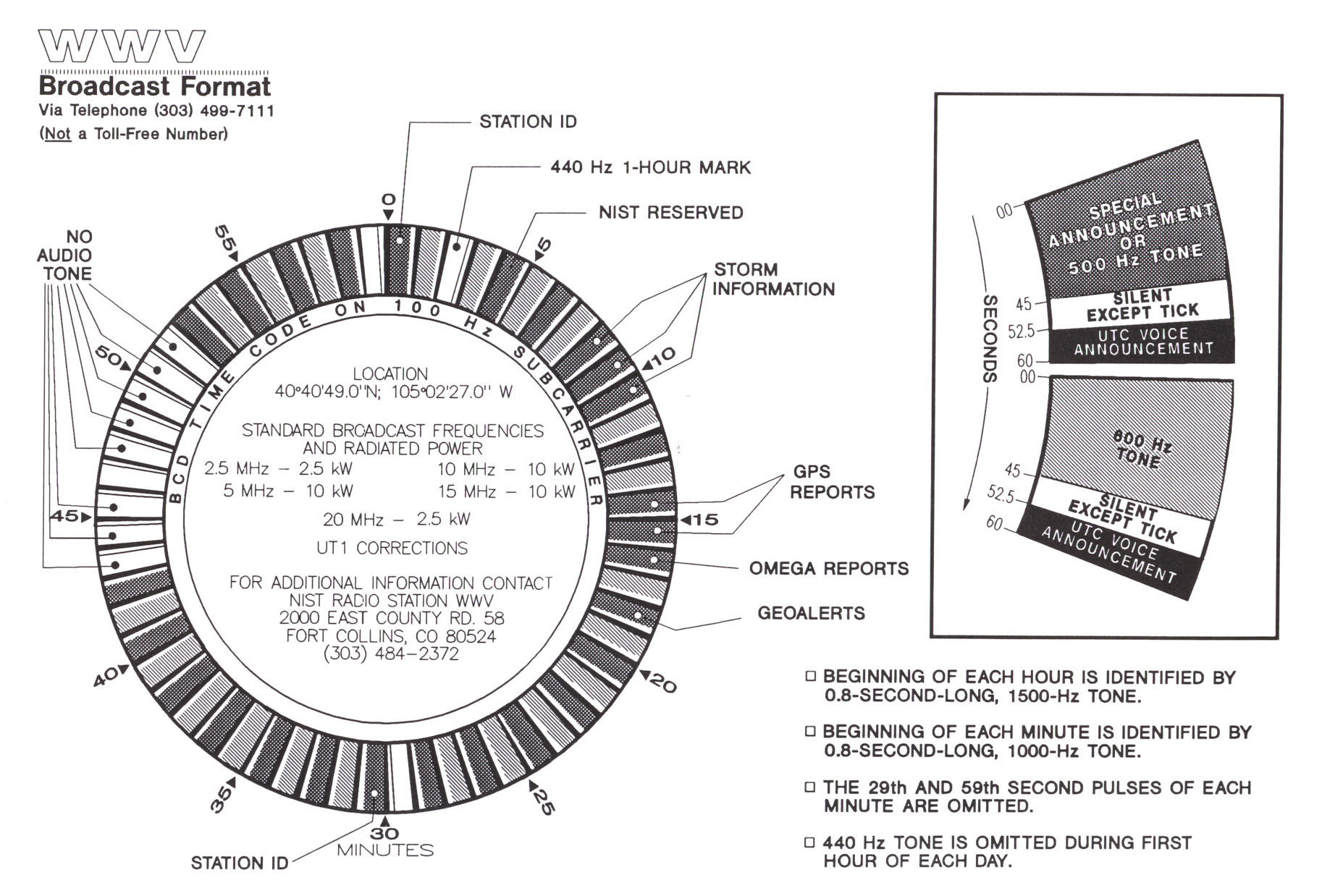
WWV Fort Collins, CO (their signal is also offered by phone: 303-499-7111)
Broadcasting on 2.5 Mhz, 5.0 Mhz, 10 Mhz, 15 Mhz, and 20 Mhz. Schedule Here. 

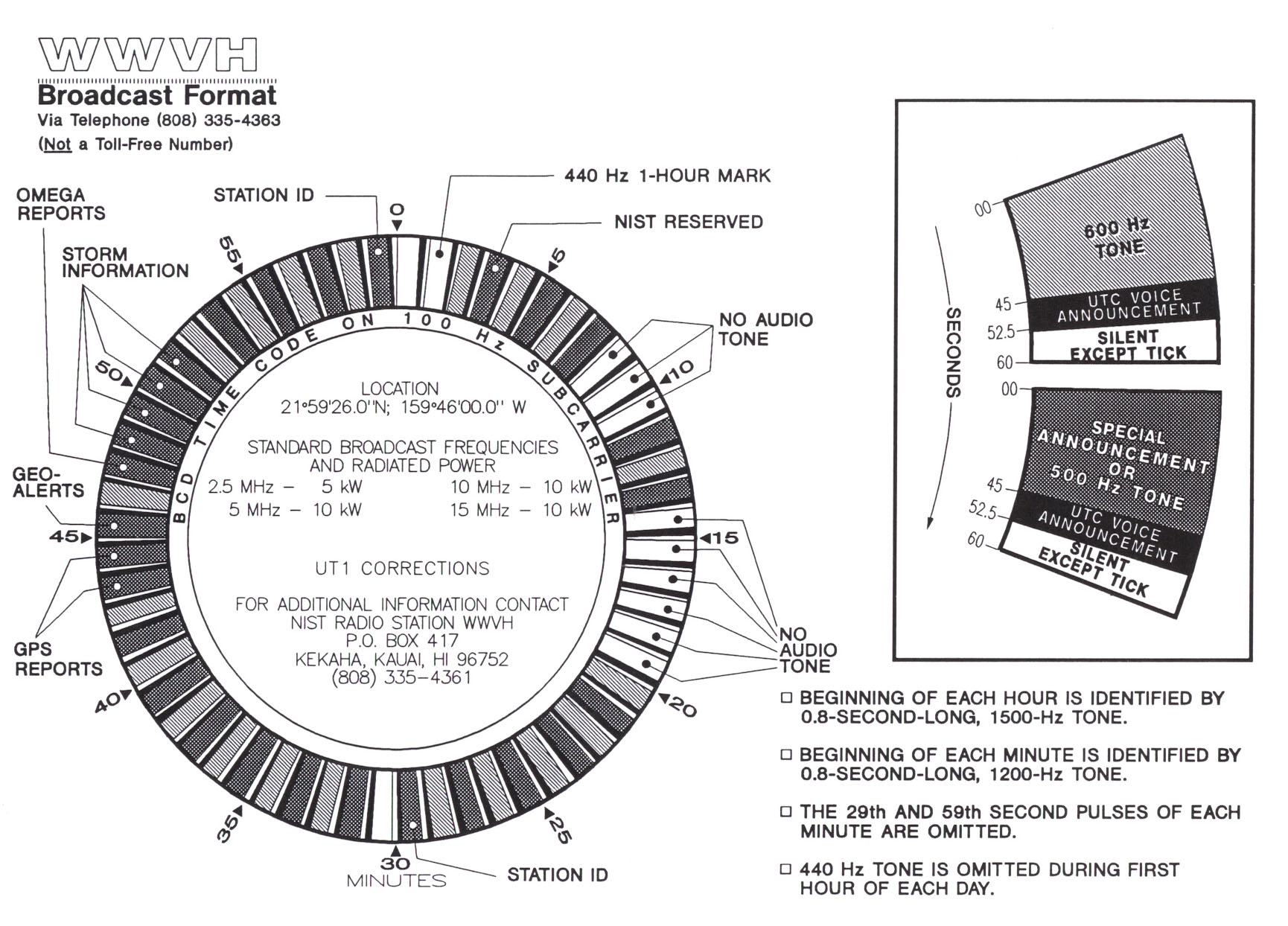
WWVH Kauai, HI (their signal is also offered by phone: 808-335-4363) Broadcasting on 2.5 MHz, 5 Mhz, 10 Mhz, and 15 Mhz. Schedule Here

WWVB Fort Collins, CO Broadcasting on 60 Khz
Official U.S. Government time, as provided by NIST and USNO, is available on the Internet Here.
And Here is a geek who made an antenna to receive WWVB with tin foil and a tomato soup can:

At the beep the time will be 5:38 PM EST...