
Showing posts with label Charles Herrold. Show all posts
Showing posts with label Charles Herrold. Show all posts
Thursday, December 13, 2012
The First Radio Station
The story of Charles "Doc" Herrold and the station SJN from Professor Mike Adams:


Thursday, February 10, 2011
First Radio Signal on the West Coast

A month later Marconi himself came to America and repeated some of his now famous experiments. So their work preceded even Marconi's own demonstrations in the new world. That team of San Franciscans included father Richard Bell, a Jesuit priest and Professor John Montgomery. Bell had studied theology in the 1890s in Rome. While there he had become interested in the work of Marconi. Marconi's earliest experiments date to at least 1888. Bell was so interested in these that when he returned to California in 1898 he brought with him a copy of Marconi's published accounts. He began replicating the small-scale experiments almost immediately."In 1899 a team of San Franciscans reproduced Guglielmo Marconi's method of communicating by radio waves and demonstrated its usefulness by sending a message in Morse code from a lightship anchored outside the Golden Gate to the Cliff House on the San Francisco Shore. This was the first wireless message broadcast on the West coast and the first ship-to-shore broadcast in the United States."
Bell began testing as early as 10 years after Marconi. Marconi did a quick U.S. visit in 1899 mostly around New york for the America's Cup race starting in Sandy Hook, NJ. He transmitted from the USS Ponce. He did not make it to the west coast. Bell continued his lectures and public experiments. In 1903 Bell and Montgomery made a 7-mile transmission from Villa Maria to college tower. Normally I'd double check that distance on a map but neither of those locations appear on any map. I suspect the locations are colloquial.
In 1906 Bell was promoted to head up both physics and chemistry at Santa Clara U. in the the Bruengo Science Building. Bell continued to experiment. He made transmissions from Los Gatos College to San Francisco, and later tackled voice transmissions with Dr. Charles Herrold. He and Herrold spoke the first transmitted words in the West coast. They were ahead of the Great White fleet by at least a year, who in California sometime in 1908. Bell for all his work patented only one device, a simple signaling unit he devised in 1928. In 1933 Marconi finally went to the west coast and visited Bell. (see image above.) Bell is the grumpy looking cuss to the left.
Wednesday, February 22, 2006
Charles "Doc" Herrold
This was a full decade before Frankie powered up KDKA.
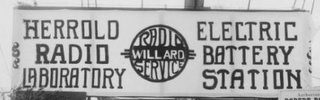
Charles David Herrold of San Jose, California is a relatively unknown broadcasting pioneer whos work began around 1912. He may have been the first to broadcast radio entertainment and information for an audience on a regularly scheduled, pre-announced basis. Over the years he used the call letters FN, 6XE, 6XF and SJN. None of these were formal, legal calls as there was no governing body to assign them. His early broadcasts were very innovative with a great number of "firsts."
Herrod broadcasted using a spark gap transmitter with a carbon element microphone. These elements burned out almost hourly making long form programming very difficult. Through experimentation he invented the "Arc Fone" Basicly it was six arc lights in series which produced a high frequency carrier signal. This unit required 500 volts. So he tapped the san Jose streetcar wires. Then he invented a water cooled microphone, the power of the device burned out the others. The Arc Fone was patented on December 21, 1915. http://users.adams.net/~jfs/herrold3.htm
in 1910 Herrold, published an ad for wireless equipment in the catalogue of the Electro-Importing Company "We have been giving wireless phonograph concerts to amateur men in the Santa Clara Valley." While his 1910 listeners were radio hobbyists, they still listened. he then went on to broadcast to much larger public audiences daily during the 1915 San Francisco World's Fair.
The real significance of Herrold was that between 1912 and 1917 he operated a radio station, programming on a regular schedule. A shceulde that was even announced in the newspapers. It is also noteworthy that the first 
He died penniless, with almost no recognition; last working as a janitor at a naval facility.
KTEH-TV filmed a documentary of his life. You can order it here: http://www.kteh.org/productions/docs/docherrold.html I plan to.
Subscribe to:
Posts (Atom)

 Posts
Posts


