Showing posts with label marine wireless. Show all posts

Monday, March 21, 2016

Key West Naval Station - NAR

Naval Air Station NAR, in Key West, FL was located only four miles east of Key West city. It was about 150 miles Southwest of Miami and 90 miles North of Cuba.  The naval air station and military airport (NQX) still lies on Boca Chica Key.  But the radio station is gone. More here.

The station's mission began in 1905 at what is now Truman Annex, when it was called the Naval Wireless Telegraph Station. Back in 1915 it broadcast time signals just like NAA in Washington, NAT in New Orleans and NPH in San Francisco among others.


NAR, was a link in a chain of Wireless Telegraph Stations in what was then referred to as the "Coastal Signal Service" of the US Navy. That chain extended from Cape Elizabeth, ME, to New Orleans. It further included wireless stations at Guantanamo Bay, Cuba; San Juan, PR and after 1910, even one in Panama.

Following World War I, the military downsized many installations. The air station and submarine base were closed and its personnel released. Many buildings on Trumbo Point were demolished. But a small Navy force stayed on to continue maintaining that wireless station at the Naval Station in Truman Annex.

But in the 1960s as the cold war ramped up, the base expanded once again. At it's peak the site employed 19 officers, 268 enlisted personnel and 31 civilians. In 1965 the Navy even acquired the 640 acres of land on Saddlebunch Key to build another transmitter site. But the cold war cooled off and the radio functions became civilian-led and operated by contractors. More here.


In 2011 the Navy began the process of closing the long-running radio communications center. Improvements to high-frequency broadcasting require fewer stations. The station was officially decommissioned on Sept. 21 2012. The station signed off in Morse code. It had been 107 years since the station first signed on.

Friday, April 27, 2012

Ship Owners' Radio Service WDT


WDT-AM signed on December 22nd 1921 in Stapleton, Staten Island. It was owned by the Ship Owners' Radio Service and operated on 360 meters. It was an early marine radio station broadcasting tide and weather information. At the time this was not exactly a ground-breaking service. In 1910 the Ship Act was passed aka the "Act to Require Apparatus and Operators for Radio Communications on Certain Ocean Steamers" This law required certain types of  ships, foreign and domestic,  to carry and use radio at U.S. ports. This was the beginning of marine wireless law and WDT followed that by a decade. What's unique is that station operated in the civilian radio band and had an FCC license to do so.

But the station was a share-time operation with WOR and WJY. How can a station provide timely information when they only broadcast for a few hours a day?  They can't. the station only existed for another two years. But that didn't stop the Ship Owners' Radio Service from expanding. A 1922 article from the Deseret News described 44 stations in their network:
"Forty-four ship radio stations operated and controlled by the Ship Owners' Radio Service increased the ship message rate from 4 cents to 8 cents per word for all classes of ship service, beginning July 1st. the radio ship stations owned by the Alaska Steamship Company, which are also owned by the Ship Owners' Radio Service, will not, however increase the present rate of 4 cents per word. "
But that article clearly refers to a telegraph service. The radio station WDT was another animal entirely. It was housed and operated by the Premier Grand Piano Corporation in June of 1923 and managed by Vaughn DeLeath, who was (at least back then)  a famous singer.  I'd like to connect the dots between her career and Premier  and WJZ but I got nada. DeLeath's career really only began in 1916, and she was performing live in New York on WJZ-AM by 1921. Then a trade magazine for Presto wrote similarly of her position in June that year:
"Miss Vaughn DeLeath, "The Original Radio Voice," managing director of Broadcasting Station WDT, made a very interesting and felicitous opening
address, welcoming the guests present and stressing the appropriateness of the linking of Station WDT with the Premier Grand Piano Corporation. Later on she participated in the program in her artistic manner."

An issue of the Pittsburgh similarly records her as WDT's managing director in August of 1923.
"The station W.D.T. is one of the most prominently known broadcasting depots in the east and is under the direction of Miss Vaugh De Leath.  She is the first director to introduce an entire Negro program and she takes great pride in hosting of such entertainment for which she receives much commendation."

One source, Allmusic, inexplicably claims she was managing a low power radio network. I cannot corroborate this, nor the claims that she was running WJZ.  On December 22, 1923, WDT signed off for the last time and sold of it's transmitter. A religious group led by Judge Joseph Frederick Rutherford bought the stations equipment to start their own station, WBBR... More here.  Ultimately the Ship Owners' Radio Service appears to have been short lived. Their only other known venture is a Crystal Detector that was manufactured by the Wireless Specialty Co. It was called the Sorsinc Stand Alone Crystal Detector, and I'm told it was identical to the Wetmore-Savage crystal detectors made by the same manufacturer.I hear there are some rare catalogs out there too but I've not seen them personally.

Friday, April 06, 2012

Ship Radiotelegraph Safety Rules

This booklet Ship Radiotelegraph Safety Rules was adopted by the FCC pursuant to the Communications act of 1934 and approved on May 20th, 1937. This booklet was printed and distributed later that year. This particular copy if marked in pencil with the date 12/16/37 so presumably that represents some kind of arrival date for the booklet. This copy originates in the collection of a state library in Massachusetts, remaindered of course.

The rule sin this book are out of date of course, but they applied then to all United States ships navigating the open sea outside a harbor or port and all United States and foreign ships which leave or attempt to leave any harbor or port of the United States. This excluded the following:
  • 1. Cargo ships weighing less than 1,600 gross tons (other requirements hereinafter specified)
  • 2. Ships of war
  • 3. Ships owned and operated by the US government
  • 4. Foreign ships belonging to nations party to the "International Convention for the Safety of Life at Sea, London 1929" carrying a valid certificate exempting them
  • 5. Yachts of less than 600 gross tons
  • 6. Vessels in tow
  • 7. Vessels exclusively navigating the area of the Great Lakes

For the most part, these rules regulated the radio units themselves and less so their operation. Regular inspections were required, as was licensing. Primarily it enforced a much earlier act that even predated the FRC. In 1910 the Ship Act was passed aka the "Act to Require Apparatus and Operators for Radio Communications on Certain Ocean Steamers" This law required certain types of  ships, foreign and domestic,  to carry and use radio at U.S. ports. The 1910 act (and its 1912 amendment) required the licensing of operators but not transmitters. Modern law is almost exactly the opposite. More here.

The original 1910 Ship act was completely neutral on make and model. This 1937 booklet is not so mild. It certifies only specific models for use as an auto alarm. In terms of transmitter and receiver, it's is more concerned with power and engineering specifics. Main and back up transmitters must be capable of operating on the distress frequency of 500 kc, the direction finder frequency of 275 kc, and between 350-485 kc. The receiver must additionally be capable of receiving transmissions between 100-200 kc and 350 - 515 kc.  The booklet goes on in great detail.

Download all 44 MB 

Friday, December 17, 2010

The Cruise of the Great White Fleet

In the book Lee de Forest and the fatherhood of Radio By James A. Hijiya I found a very arcane reference to a piece of radio history. In passing he quotes a 1940 article by G.H. Clark that refers to broadcasting on "the Navy's round-the-world-cruise of 1907-09." I had never before heard of the event.  He describes an operator who played phonograph records over the wireless. These devices transmitted speech instead of Morse Code.  This was so early in the history of radio that he describes that in the news account the operator "gave out" the music as the word "broadcast" was not yet used in that context.
"Late in 1907 the Radio telephone Co. installed wireless apparatus on ships of the U.S. Navy before they embarked on a round-the-world cruise. (The sets did not work well, but de Forest blamed that on the haste with which they were installed and with which Navy operators were trained.)"
It was called the Cruise of the Great White Fleet. On Dec.16, 1907, President Theodore Roosevelt sent a fleet of U.S. battleships around the world. They did not complete the circumnavigation of the globe until February 21st 1909.For the record, the color "white" was not racial.  In 2004 journalist Mike McKinley explained it:
"Altogether, 16 battleships and 4 destroyers, together with additional support ships, were assembled at the Brooklyn Navy Yard ready to make the 14 month tour around the world. All of the ships were newly painted a gleaming white and hence the flotilla became known as the "Great White Fleet".
Each of the 16 ships bore the name of a U.S. state, except for the Kearsarge and each was assigned a call sign for each transmitter. Some callsigns appear to have been just abbreviations The Georgia was GC for example.  Others like KSZ on the Virginia were internationally accepted callsigns. The U.S.S. Ohio carried the main network transmitter. All told de Forest sold 26 sets to the Navy in 1907. The USS Connecticut served as it's flagship. They began at Hampton Roads, VA and from there hit more than a hundred remote locations: Honolulu, South Africa, Egypt, Australia, New Zealand, Japan, Cuba, Italy, Chile, South America to California. and so many more. It was a saber-rattling move that was typical of Roosevelt. Wireless had been used in the Russo-Japanese war and he felt America was now competing with the Imperial Russian fleet. He still called it a goodwill tour. More here.

In 1965 Robert Hart wrote a book about the it. He described these transmitters as "rudimentary wireless sets." More here. But simple or not, communication between ships, while still maintained to some extent by semaphore and signal flags, was now principally by wireless telegraphy.  This was a big change. These ships didn't have radio before the trip. They had new equipment and novice operators. They sent messages to other ships and to the ports to schedule their arrivals replete with crowds and parades. Captains reported the events of their stops directly to President Roosevelt and also with the land-based station CC on Cape Cod.

Some navy ships had wireless sets as early as 1902, but captains were mixed on them. Of course at this early stage of development they were difficult to use, but it wasn't about that. For every useful tidbit of information they were able to send and receive, there were also orders from their superiors. In short, wireless was a challenge to the immediate autonomy of a ships captain. It's been recorded in some sources that Captains often ordered them shut down and that calls be ignored. When the ships returned in 1909, the wireless sets were uninstalled. The navy's interest in wireless stalled until 1917 and the beginning of  WWI.

Monday, October 25, 2010

The Etymology of Pirate Radio

The illicit nature of pirate radio dovetails with the maritime roots of wireless. There was no such thing as pirate radio before 1912. There was no FCC until 1934, there was no FRC until 1926. Radio was essentially unregulated. The London Radiotelegraph Convention in 1912 produced some of the first broadcast regulations, and the reason was a supposed problem with ship-to-shore transmissions.

Pirate (n.)
Meaning "one who takes another's work without permission" first recorded 1701; sense of "unlicensed radio broadcaster" is from 1913. The verb is first recorded 1570s. From the Greek peirates, Latin Pirata meaning brigand.
On April 17, 1912 the New York Herald ran the headline "President Moves to Stop Mob Rule of Wireless." Then President William Taft had taken an interest in regulating the wireless. (It was an election year) Four months later congress passed the "Act to Regulate Radio Communication." It created a system to assign call letters and allocated frequencies. By creating legitimate, licensed radio, by default they also created pirate radio.

Despite the 1912 date, I found a no references contemporary to that era. Pirates were still swashbucklers and not broadcasters in that decades. It is easy to find references from after 1940, very had to find them before 1930. As always it's difficult to ascertain the absolute first usage, change is always more cumulative in terms of changing language. Below I list several notable references. You can see as they move back in time the words pirate and radio are still used in context, but not in conjunction. The illegality becomes about the patent violation or use of the use of the frequency allocation. In other words, it becomes a verb.But from the quotes used in that 1935 reference you can see it's usage was still tenuous."

1936 - Popular Mechanics (January issue)
"Without knowing it, you probably have encountered the invisible "pirates" of the airwaves—those racketeers of space who today constitute a threat to national and international broadcasting of news and information."

1935 - Intermedia: Volume 13
"Their appreciation of music is clearly that which has been labeled 'young' over the years (funk, soul, rock, disco, etc); they have no significant preference for pirate radio stations as compared to others."

1934 - America: A Catholic Review of the Week
"In Havana however anti-American feelings have not subsided. On the heels of a broadcast from a pirate radio station urging action against American financiers and their property, the Woolworth store was bombed on October 17 with damage estimated at $2500. "

1934 - Modern Mechanix,  (March Issue)
 "All the so-called “radio pirates” are not across the border or out on the high seas. A. D. Ring, principal engineer of the-federal radio commission, says that at least 200 outlaw stations have been under surveillance in the United States alone."

1933 - Time magazine, Volume 22, Issue 9
"...Last week the Oppositionists, though their leaders still maintained contact with Mediator Welles, broadcast throughout Cuba from a pirate radio station..."

1931 - Popular Mechanics (August Issue)
"Monitoring of stations operating on the frequencies which can be measured at Grand Island cover the following classes of service transoceanic, telegraph and telephone, marine, broadcasting amateur, television and facsimile—to say nothing of the pirate stations among which is to be numbered the bootleg station"

1927 - Radio Broadcast Vol. 11
"...at the moment, the very foundations of broadcasting are threatened by the effort of a few inferior pirate stations to set aside the Radio Act..."

1926 - Wireless World: Volume 19
"Innumerable pirate builders of radio sets belong to these societies who must damage the legitimate radio manufacturer..."

1926 - The Outlook, Volume 143
"Secretary Hoover has expressed the opinion that National radio conferences are at an end until Congress passes legislation. In the meantime if stations continue to "pirate" wave-lengths broadcasting will stir the ether..."

1926 - The Century Magazine (October Issue)
"Until Congress acts this winter the temptation to pirate some other station's time or wave-length will always be present..."

1918 -  House Committee on Merchant Marine...
"Very early—as early as 1904—the Navy Department began equipping naval vessels with piratical apparatus purchased from companies that made apparatus and sold it embodying the Marconi patents. The Marconi Co. protested to the Navy Department against that practice, and said it was not fair to a patentee to have the United States Government, which granted the patent, accept goods and buy them from a pirate."

Thursday, June 04, 2009

Z-Codes

That issue of The Amplifier had a few words that caught my eye. Notably ZCF, ZSF, ZWA, and ZZA. They looked familiar but I couldn't place them in my world of shortwave. I consulted a couple other geeks and one recognized them as military but was unsure. Turned out he was right.

Sending data by wireless was difficult. Abbreviation made things faster, so early on there were both formal and informal competing systems. In 1912 the International Radio Telegraph Convention standardized the Q-codes. This was a big step but the European military was already using X-codes, and Cable & Wireless Ltd. was already using Z-codes on their land lines. Cable & wireless is the British Communications company that manufactured the sea cables that interconnect the British empire. In 1942 the U.S. military asked the allies to drop X-codes infavor of Q codes. In the midst of WWII they were willing to standardize.

But strangely the U.S. millitary after WWI moved onto use Z-codes as did NATO. Because of that dual commercial/military heritage some Z-codes have more than one meaning. I'll start with the four above translated to plan English
ZCF - Please check your center frequency
ZSF
- Send faster
ZWA
- ?
ZZA
- ?

Notice those last two are unknown. Let me explain that a little bit. They're used multiple times in the CCC shortwave notes but are not standardized Z-codes. Codes from ZAA to ZXZ are standardized in the military code book. Z-codes from ZYA to ZZZ are reserved for temporary assignments so we can assume these had special meanings unique to the CCC. Perhaps some living radioman of that era will fill us in. More here.

The Z-codes (like the Q-Codes) are standardized today by NATO through the publishing of ACP-131. Howver, it's important to note that the first edition of ACP-131 was published by the U.S. military. Because it was classified at the time I dont have a copy of that edition, btu I do have a pdf of a 1964 edition that was probably close: Here

Monday, September 17, 2007

"Hooke dismantled wireless"

On September 15th 1915 the entry by Joseph Russell Stenhouse was brief "Hooke dismantled wireless, heartsick." I think That's Hooke on the far right last row...Hooke was The Ship's Wireless Operator Mr. Lionel Hooke, and for weeks he'd been struggling with the marine wireless set aboard the ship HMS Aurora trying to increase it's range. He'd managed to catch messages from Macquarie Island and Awarua. But then on September 5th a brutal storm tore off the mizzenmast. The aerial had been bolted to it and they both went into the Ross sea.

The ship had been waiting for Sir Ernest Shackleton to cross Antarctica and had become trapped in pack ice. The wireless set was their means of communication with the outside world. Weeks before Hooke had written "We are nearly 100 miles offshore, barren at that & it is a horrible situation." Sadly his estimate of 100 miles was wrong. First officer Stenhouse estimated in his own log that they were 250 miles from shore. More here.

Stenhouse encouraged Hooke to keep trying. he probably was trying to prevent total depression for the whole crew but also genuinely needed the wireless. The pack ice was crushing the ship. The bilges couldn't keep up and men had to pump. The 5-ton rudder was destroyed... their odds of surviving were poor.

Previously the wireless set had almost electrocuted Hooke. Around May 7th he'd been sending daily messages to New Zeland, Awarua, and Macquarie Island. The range of the set was about 300 miles, but he'd not been receiving messages. He noticed one night a humming noise and gone to investigate the transformer. He was shocked by 9,000 volts. The grooved porcelain insulators had become encased in ice and were draining the current. But Hooke was only 18 years old. He was enthusiastic and had been trained as a wireless operator in Melbourne. This was his third assignment at a shipboard wireless operator. More here:

Finally on March 23rd after fifteen months Hooke tinkered, the wireless back to life. They received some crackles of Morse code. It was the wireless station on Awarua. While observing their unwilling radio silence, landing parties had terrible problems. Other ships did not even have wireless. They were bombarded with questions from press sources on 3 continents. They held on for a few more weeks and managed to limp back to Australia where a rescue mission was sent for the remaining men. Read the book.

Hooke returned home and worked for the Royal naval volunteer reserve. In 1920 he started his own radio station. He founded the AWA wireless concert service hosting the first theatre broadcasts in Australia. He dedicated himself to a lifetime of radio work, upgrading radio stations, inventing a automatic distress transmitter for ships, and eventually became the chairman of the AWA, A lifetime radioman. Today the most prestigious electric engineering award in Australia bears his name. The Sir Lionel Hooke Award was first awarded in March 1997. Sir Lionel George Alfred Hooke was knighted in 1957, more here.

Friday, October 28, 2005

Titanic wireless

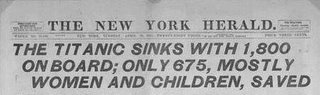
We all have read about David Sarnoff alone, manning the shortwave to get announcements from the coastguard on survivors of the Titanic sinking. Nobody ever seems to tell us about the radio crew actually on board the Titanic. Who sent the message?
The two men, who ran the Wireless room onboard the Titanic were Jack Phillipis (age 25) and Harold Birde (age 21.) These two men were very brave and stayed at their post while the ship capsized. They sent distress messages until the water was coming up the Deck. At the end the boiler was flooded and power died. Only then when they lost the ability to transmitdid they cease. Only one of them survived; Jack Phillipis drowned that night.
http://www.hf.ro/

NOTE:
CQD was the customary distress signal until the more contemporary SOS was popularized after the Titanic sinking. CQD was an adaptation of the general call for attention: CQ with an added D for Danger. CQ derives from "pay attention" in what was then the official international postal language: French! The full broadcasted distress signal was CQD DE MGY CQD DE MGY CQD DE MGY followed by the position of the ship. The “DE” in this signal also derives from French Post meanong “from.”

So, CQD MGY were the letters of distress flashed from Titanic late on the night of April 14, 1912. But they were not sent in that order, nor were they broadcast with ease. In fact their calls for help were barely heard by many. But why? The Titanic's "wireless" equipment was the most powerful in use at the time. The main transmitter was a rotary spark design, powered by a 5 kW motor. http://www.oceanliner.org/titanic_radio.htm

The equipment operated into a 4 wire antenna suspended between the ship's 2 masts, some 250 feet above the sea. They even had a battery powered emergency transmitter. The main transmitter was housed in a special room, was specially insulated to reduce interference to the main receiver. The equipment virtually guaranteed working range of 250 miles, and up to 2000 miles at night!

The Problem was this: There was a viscious rivalry between firms providing steamship wireless equipment. Ships with different wireless sets from different companies did not communicate with one another under normal circumstances. Operators cursed each other, and even jammed transmissions. Because of this Jack Phillps opted not to struggle through language barriers with a foreign ships which might be rigged with competing equipment! In addition to that, he had been given informed that the ship was NOT ACTUALLY SINKING. His messages were focused on getting passengers transferred to other ships so that Titanic could be temporarily fixed and towed to safety.

Thursday, August 11, 2005

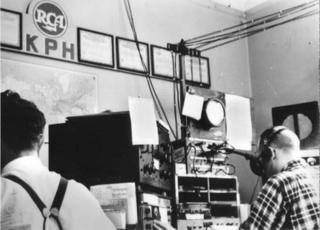
KPH: The Wireless Giant of the Pacific

Every year on August 12th KPH returns to the air for one night...

According to the Maritime Radio Historical Society, the station would have been 100 this year. It began in 1905 as Morse station "PH." (Remember back then call letters were voluntary. You could make up anything you wanted.) The call letters referred to the Palace Hotel in San Francisco, where the station was located. Later, regulators later added the K to the call sign. KPH was once known as the "Wireless Giant of the Pacific."

For almost a century, marine wireless operators heard steady dots and dashes of the KPH signal in their earphones. At KPH some of the best Morse operators in the country listened for calls from ships. Most messages were routine. But occasionally an S-O-S would come in and KPH operators would jump to respond. The station went silent in 1997; two years before the formal end of commercial Morse Code use in the United States.

The annual event is July 12 this year; it is held at Point Reyes Station in California. Organizers have invited the public to watch professional Morse operators, including several original KPH operators, work the station. The station moved its transmitters and receivers to West Marin in the 1920s. The Maritime Radio Historical Society keeps it alive, with cooperation of the Point Reyes National Seashore. The Point Reyes National Seashore currently owns the land and buildings and all the artifacts of KPH.