Showing posts with label WMT. Show all posts

Monday, May 18, 2026

Sherrif Tom Owen's Cowboys on WMT


June 18th, 1953 - Eldora, IA

The first thing you might notice about Tom Owen's Cowboy's is that their leader, and namesake is at least 20 years older than the rest of the group. I'll get to that in a moment. Their first appearance in the Radio Guide is in December of 1938. The 15-minute show aired M-F in the morning. Different Radio Guides have them at 10:45, 11:00 and 11:15 depending, but all times CST. In the 1940s their slot moved around, and they began playing the "WMT News" Program on Wednesdays at 1:45 exclusively. In 1941 they moved around and played more Noon and 1:00 slots, playing a 15 minute spot before :Voice of Iowa News." Joe Doakes appears to have taken the news/music role.

Most of what I know about the line up of Sheriff Tom Owen's Cowboys' starts with three post cards which have hand notes identifying the members. None of them have been mailed, so we have no dates attached to any of the three. But I have some dating conjecture... Let's start with that short discography:

Label Sides Year
 Mercury  A New Ten Gallon Hat / You Can't Cry Over My Shoulder 1946 
Mercury  Down By The Railroad Tracks / The Freight Train Blues 1946
Mercury   Don't Say You Love Me If You Don't / Baby You Done Flubbed Your Dub With Me 1946
Dome Down In The Sweetheart Valley / Hey! Hey! Ioway Polka 1948
Mercury  Just Because / My Darling Tell Me True 1948
Dome I Send Back Your Letters / The Trouble With Me Is You 1949
 Mastertone  Man, Man, What A Band / The Cowboy's Dream ????

Their entire known discography consists of seven 78s all released between 1946 and 1949. Some of their 78's attribute song writers, but none that were definitively written by band members. Even the Owen behind (W-1010-A) "Man, Man What A Band" is Harry Y. Owen. That disc is interesting. It is also one of the few items in their historiography which lacks a WMT logo, and Tom Owen lacks the title Sheriff. I suspect it's their first release, and that it came early in the WMT radio program because Mastertone was a local Des Moines, IA label. It did credit some players: Chuck & Johnny on side A and Jim, Chuck & Johnny on side B. So I believe those three belong to the original line up.

But Sheriff Tom Owen's Cowboys' had a few different line ups. The image above looks like Tom (calling), Charles "Chuck" Youtzy (trumpet), Mibs Allen (drums), Johnny Lyons (accordion), Harold "Bub" Goodwick (clarinet), and Jim Pye (bass).  It's similar to the below pose but the bass drum head is different as is the line up. It look more like a candid than a pose because of the gap between Tom and Jim.

The line up below is Tom (calling), Jerry (accordion), Don Wachal (Clarinet), Mibs Allen (drums), Johnny Kettleson (guitar), Bub (trumpet) and Jim (bass).  Supposedly at some point Leo Greco played accordion. (I've added surnames where possible) More here. Tom Owen's sheriff costume was really just a suit and a badge but sometimes he wore two holsters on his hips with pistols.

I found another image (below) with a line up that looks like Tom, Chuck, Don Wachal, Mibs, Bub Goodwick, Gene and Jim. There's also one of them piled in a wagon: Tom, Chuck, Don, Mibs, Bub, Johnny, Jim and Don...  I take this horse carriage promo picture to be the latest one. The band is wearing monogrammed chaps. More here. In January of 1946 they got a write up in Billboard claiming they were booked solid for all of 1946. 

This phenomenal gent was Sheriff Tom Owen and His Cowboys, a six-piece band that does a business which makes other combos envious. Playing in a 100 -mile radius of Cedar Rapids, IA., where the cowboys play a daily program on Station WMT, the band is the hottest thing for box-office receipts to hit the territory. The band will gross $72,000 for 1945 plays 1,400 - 1,600 consistently...

Billboard went on to explain they play the old-time music of 25 years ago with a zip to it, westerns, Hillbilly and some modern. By Modern he means 1940s country. That's a funny thought, today we'd call it all country oldies. Tom Owen's career apparently goes back to WLS where he was a square dance caller where he worked for 13 years. The trio recorded 8 sides in Gennett’s studio, in Richmond, Indiana on February 1926.

Artist biographies are often embellished but Tom Owens recorded previously was the Tom Owen's WLS Barn Dance Trio which whom he recorded 7 discs in 1926 and 1927. [SOURCE] The members of that band are poorly documented but Tom Owen is a given, and Tommy Dandurand is credited as the fiddler player on most of them, something musicologists grant is possible. Those discs were issued on Silvertone, Challenge and Gennett. One article about the WLS Barn Dance Trio reports that Tom Owen is from Missouri.


I don't think that's Tom Own's only bands.  One Gennett discography reports that the band uses the name Uncle John Harvey’s Old Time Dance Orchestra on Herwin. [SOURCE]  I also found an image where Tom Owen is posed next to a group with a bass drum painted with the logo for "Tom Owen's WLS Entertainers." I also found a few Gennetts with the name Tom Owen's Barnstormers, a newspaper listing Tom Owen's Cornhuskers. I think that's the band with Matt Hickey. It's all probably the same group, more or less affiliated with the WLS Barn Dance. (discography below) More here.

The WLS Barn Dance was only debuted on April 19, 1924. So Tom Owen was a very early figure. For his start the book Exploring Roots Music by Nolan Porter told the story. "As a listener that night, I remember that a request went out for a square dance caller and the announcer reported: "Tom Owen, a hospital worker, telephoned that he used to call dances down home in Missouri and he'll be right over." Such things did happen in those early days of radio. The story is canonized in the 1969 book Prairie Farmer and WLS by James Evans.

The Daily Iowan 10-10-1952

The National Barn Dace website lists Tom among the early stars. "Early stars of the National Barn Dance included Tommy Dandurand, Tom Owens, Chubby Parker, Pie Plant Pete, Walter Peterson, Rube Tronson and Cecil & Ethel Ward among others." [SOURCE] You wouldn't think a square dance caller was such a big deal but they were re-creating a type of music which was already considered old-timey. As the Barn Dance Trio Tom Owen's recorded the below. You can see the later three are re-releases.

Richard Peterson in the book Creating Country Music claimed that Square dance calling only constituted part of the WLS Barn Dance radio program from 1924 to 1929. That could have also been the end of Tom Owen on the program but a 1935 issue of Radio Guide suggests Tom Owen was still on air. We know he was at WMT in late 1938 so instead of a gap there may even be an overlap.

Label Sides Year
 Silvertone Ocean Waves / Kings Head 1926 
Silvertone Stoney Point / Buffalo Girls  1926 
Silvertone Buckwheat Batter / The Irish Washerwoman  1926 
Silvertone Hell On The Wabash / McLeod's Reel 1926 
Gennett Stoney Point / Ocean Waves *1926 
Gennett Buckwheat Batter / Hell On The Wabash *1926 
 Challenge  Ocean Waves / Buffalo Girls *1927
 Herwin Buckwheat Batter / Hell On The Wabash ????

In 1949 Tom Owen appeared with Pat Barrett, aka Uncle Ezra, Bradley Kincaid, Malcolm Clair, and Joe Kelly to celebrate the 25th birthday of the WLS Barn Dance. In September 1952 Feedstuffs (a trade newspaper for the feed industry" listed Tom Owen and his Cowboys playing an industry event. Then he appeared again in 1952 for it's 28th birthday alongside Ford Rush and Glenn Roswell. In 1952 there's an ad for a dance Tom Owen's Cowboys are playing, it refers to their 16th WMT anniversary. That'd put their start in 1936 or 1937. This may even overlap with Tom's time touring with his Entertainers in 1937 as a "WLS artist" but probably no longer on the air at the Barn Dance.

Tom Owen died in 1956. Variety wrote "Tom Owens, 63 bandleader who headed a western music group known as Tom Owens's Cowboys died May 27th in Cedar Rapids, IA after a long illness. He joined radio station WMT, Cedar Rapids, in 1937 and continued with that outlet until his illness. Surviving are his wire, daughter and son." The Cowboys had been on WMT for about 20 years. Owen's radio tenure included at least another 10+ years  at WLS.

Arlington Heights Herald, 07-29-1932

In January and February of 1958 Sponsor and Broadcasting magazine carried an ads for a country special on WMT, Noontime RFD, which lists Tom Owen's Cowboys. But there the trail ends. Some ads for that Noontime RFD program co-branded Owen and Johnny Kettleson. The group photo no longer includes Owen but they kept his name at least on the print ads. 

Johnny Kettleson played with his own band from the early 1950s into the early 1970s. Their short-lived accordionist Leo Grecco started Leo & The Pioneers, which eventually became the Leo Greco band. He broke into television and started his own WMT-AM radio program on Sunday mornings "Variety Time" which ran for decades. Charles "Chuck" Youtzy might have become an electric utility worker at Jo-Carroll Electric. Harold ‘Bub’ Goodwick had previously been in the Glen Victoria Band and he left Tom Owen's  Cowboys in 1949. In 1952 he started Bub and His Boys in Illinois with his brother Donovan. He continued to perform until his death in 1991. Like with Tom Owen, his band carried on for another few years. [SOURCE

But in a strange kind of serendipity Sheriff Tom Owen's Cowboys were mentioned in Billboard in 1995. Mercury released a 50th anniversary Country music box set which included 73 artists who recorded between 1945 and 1995. The first name was Sheriff Tom, the last name was Shania Twain. What a mismatched  pair of bookends.

Monday, June 08, 2020

A Decrease in Broadcasting?


I was wondering the other day if the number of broadcasters has ever decreased. In modern times, it seemed possible as listeners move away from the AM band. But it hasn't happened yet. Even in Canada where the AM band is almost shuttered, those same broadcasters largely moved to new frequencies on the FM band. To find even a rumor of such a reduction, you have to go back to the very inception of commercial radio broadcasting. In my research I found a single Radio World article from November 18th, 1922 which indicates an actual reduction in the number of broadcasters. Spoiler: the title was just click-bait.

Now in 1922 that claim was more plausible, even while it came packaged with an exaggerated concern that radio might die out altogether. Today we see equally dramatic predictions of death for all kinds of media: AM, FM, satellite radio, TV, cable, and newspapers. Much like the perennial dire predictions on the death of rock n' roll, it was all premature. The end of  radio was not a real threat in 1922 any more than it would be in 2020. Here was the situation:

In October 1922 a total of 56 radio (land) stations were licensed to broadcast and 22 were deleted. That's a net increase of only 24 radio stations. But by the first week of November there were a total of 533 broadcasting stations operating. 19 of them were operating on 400 meters and 519 of them on 360 meters. It sounds a bit crowded. But somehow by the end of that week another 11 more station were licensed. These are listed below. The Frequency is in meters, and the power in watts.

City/State Frequency Power Callsign Owner
Pendleton, OR 360 100 KFFE Eastern Oregon Radio Co.
Macon, GA 360 750 WMAZ Mercer University
Council Bluffs, IA 360 10 WPAF Peterson's Radio Co.
Lincoln, NE 360 250 WSAS State of Nebraska
Austin, TX 360 100 WNAS Texas Radio Corporation
David City, NE 360 20 WRAR Jacob C. Thomas
Walla Walla, WA 360 50 KFCF Frank A. Moore
Honolulu, HI 360 40 KYQ Electric Shop
State College, PA 360 1 WPAB Pennsylvania State Coll.
Waco, TX 360 50 WWAC Sanger Bros
Springfield, MA 360 600 WBZ Westinghouse Electric

That said, there are some incongruities in the list Radio World published (above). Most of the entries seem to belong to the "Additions" list from the November Bulletin. But KYQ wasn't granted in the November Bulletin, it was listed in December. Also WBZ signed on in September of 1921. It has no business being on the list at all. But that does not address the 27 stations excluded from their list. More here. Below are the actual additions from issues 65 - 68 of the Department of Commerce Radio Bulletins of 1922. The month of November had more new radio stations, not fewer.

September 1st, 1922 - No. 65 (46 new stations)


October 1st, 1922 - No. 66 (49 new stations)


November 1st, 1922 - No. 67 (38 new stations)

December 1st, 1922 - No. 68 (38 new stations)

So where did this panic-mongering originate? The below 21 stations Radio World listed as deleted in that fateful month in October of 1922. In the Commerce Department Bulletin they used the phrase "Strike Out All Particulars."

City/StateFrequencyCallsignOwner
Savannah, GA 360 WGAV B.H. Radio Co
Bluefield, WV 360 WHAJ Daily Telegraph
Corinth, MS 360 WHAU Corinth Radio Supply
Worcester, MA 360 WDAT Delta Electric Co.
Toledo, OH 360 WHU The William Duck Co.
Erie, PA 360 WJT Electric Equipment Co.
Yakima, WA 360 KQT Electric Power & appliance
Zanesville, OH 360 WPL Fergus Electric Co.
Carrollton, MO 360 WLAB George F. Grossman
Lindsborg, KS 360 WDAD Central Kansas Radio Supply
Portland, OR 360 KYG Wiliam P. Hawley Jr.
Holyoke, MA 360 WHAX Holyoke Street Railway
Buffalo, NY 360 WWT Mccarthy Bros & Ford
Springfield, MA 360 WIAP Radio Development Corp
New Orleans, LA 360 WBAM I.B. Rennysen
Rochester, NY 360 WHQ Times Union Inc
Butte, MT 360 KFBF F. H. Smith
Jacksonville, FL 360 WCAN Southeastern Radio Telephone
Spokan, WA 360 KOE Spokane Chronicle
Norwood, OH 360 WIAL Standard Radio Service Co.
Portsmouth, OH 360 WDAB H.C. Summer & Son
Richmond, VA 360 WBAZ Times Dispatch Publishing

But this list too is somewhat dubious. The Department of Commerce Radio Bulletin combines deletions in the same section as corrections. Again the Radio World list and the Bulletin are similar, but not identical. From the published list Radio World excludes WMT. Possibly just human error.  But maybe here is where the panic began.

In October (Bulletin No. 66)  the Commerce Department deleted KUXP, KDMK, KDIZ,WSK, KDGT, and WBAT; a mere six stations. In September (Bulletin No. 65) they deleted only two: KNR, and KZI. The previous August (Bulletin No. 64) they deleted just 3 stations: WQX, KDRO, and WQC. So perhaps in November, when the Alterations list suddenly grew by an exponential order a little panic set in.

Wednesday, March 02, 2011

NARFD or Not

The National Association of Radio Farm Directors (NARFD) was founded in 1943. These were very different years in terms of radio programming. In those days Billboard actually had a category for "Farm Programs" in their Best Local Program Competition. Today the format is leaner and more insular than ever. And from the start, their annual meetings documented the diminishing presence of farm programming. NARFD in some ways had the very basic purpose of changing that. They wanted to sell Farm Programs outside of their local markets. At a meeting in 1948 it was admitted that less than one third had managed to do so. NARFD had only 140 members in that year.
NARFD executives tended to serve repeatedly and often went into government especially the USDA whom they had close ties to. It's first President Chuck Worcester of WMT-AM was unseated in 1946 and Layne Beaty of WBAP-AM took over as Chuck moved down a notch to become VP. Beaty later served as an information advisor in Europe with the U.S. aid programs; and from 1954 to 1980. In 1949 Roy Battle of WLW became president and Phil Alampi of WJZ became VP. Alampi had his term at the helm a few years later. His wife Ruth read a poem at their 1947 banquet "The Lament of the Forgotten Women—RFD's wife."
That same year the USDA cut back on the funds it had been using to support agricultural radio programing and NARFD was caught off guard. They were powerless to change the decision so they issued a terse statement that blamed no one directly but instead mourned their collective shrinking importance.
"We regret the circumstances which have compelled curtailment of funds and personnel to an extent which severely limits the ability of the USDA radio services to adequately serve agriculture and which also limits assistance to radio farm directors in providing adequate farm service to listeners." 
While big market AMs bought FM sticks and expanded into TV NARFD stations barely limped along. Station managers dissatisfied with unprofitable farm departments cut them back or cut them off.  They needed a game-changer. In 1955 NARFD became the National Association of Television and Radio Farm Directors (NATRFD.) IN the move they increased their ranks to almost 500 members. membership to 500. The name changed in 1964 to the National Association of Farm Broadcasters (NAFB). In 2005, the name was adjusted to National Association of Farm Broadcasting (NAFB)needling over grammar.
Chuck continued on at WMT into the 1950s. Fifty years later, President Chuck Worcester is not forgotten. They award Chuck Worcester Scholarships to this day. I haven't heard it yet, but his voice is recorded on the WMT Voice of Iowa LP released in 1962.

Friday, April 11, 2008

MLI to DSM

Moline isn't a metropolis. In fact it takes four towns banded together to call itself quad Cities: Moline and Rock Island Illinois, Bettendorf and Davenport, Iowa. Strangely some folks count East Moline as a 5th and Separate City. I can state for the record it smells different than the rest of Moline.. kind of like Sour Cat food. It sticks with you. (I thought I left something bad in the hotel rooms trash can)
But I did have my best meal of the trip. I had lunch at cafe Fresh just because it was close and was wowed. A totally unexpected good meal is very welcome after a few days of tuck stop food. Next door was a small antique shop where I stopped for a minute waiting for the rain to let up and I was greeted by a thick stack of 45s, a fine and friendly greeting. I picked up some old Stax singles, including a little something by Booker T & the MG's. The single is S-137 Chinese Checkers / Plum Nellie. yes you should be jealous. That came out way back in 1963. There's an obsessive discography here.

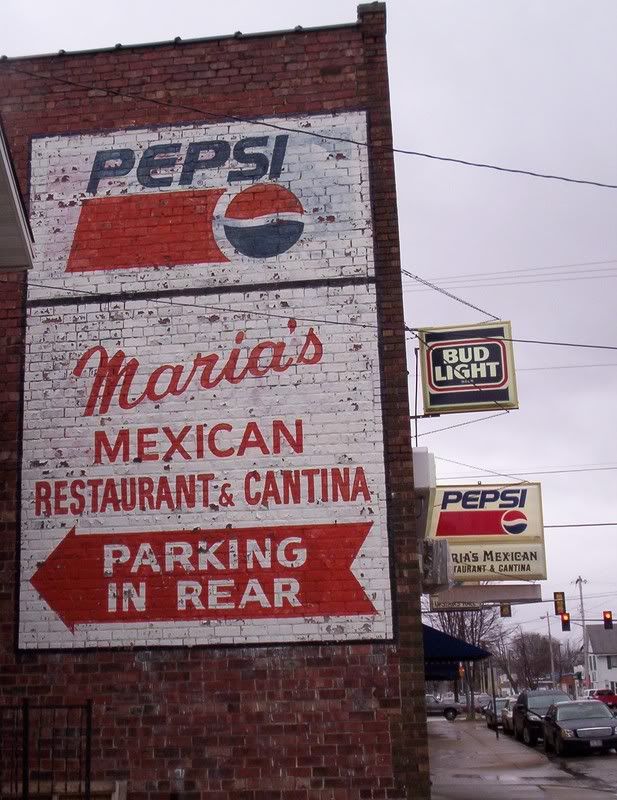
I also hit the Salvation army on 19th street where they had the biggest selection of 45s I've ever seen at a thrift store. It was truly huge. It was also next to Maria's Mexican Cantina and a bakery with a line out the door.

I listened to KALA and KUNI while in town then headed off further west into Iowa that night. There is nothing between Quad Cities and Des Moines. It's not pancake flat, the hills are low but they are still hills. The land was flooded in places, and the sandy peaks of the corn fields were washing out onto Route 80 west. I stopped for Gas in somewhere near Iowa City.

There I heard something that sounded like sirens. I got in my car and flipped on the radio and was greeted by an EAS alert. There was a severe weather warning from the national Weather Service. On 600 AM WMT I found out that in fact there were tornado sightings and that the worst of it was in the area between Keokukl County and Marengo. Minutes later there was a report of a tornado in Williamsburg heading north toward Route 80 between mile markers 124 and 136. I wondered out loud where that was. It turned out to be where I was.

Dark clouds closed in and I caught non -stop coverage of it on several channels many openly mocking the national weather service for refusing to issue a tornado warning. It got very windy and the rain became heavy enough to nearly stop traffic. then off to the south I saw a thick black cloud that was undulating and below it everything was blurry. I actually passed it around Ladora, and in the rear view mirror it seemed to peter out somewhere among the muddy fields and corn stubble before reaching pavement.
I hit Grinnell shortly thereafter and heard KDIC for the first time. they were playing an unlistenable mix of 80s pop and IDM. there mission is fully intact. In Des Moines despite the abundance of non-coms KGVC, KDRA, KWDW, KDPS, I stayed tuned to WOI looking for more storm information. That night the storms continued, but there were no more sirens and my flight out even left on time in the morning.