
Showing posts with label Fidelipac. Show all posts
Showing posts with label Fidelipac. Show all posts
Thursday, September 08, 2011
More on Cart Machines
This is a great dog & pony show about Fidelipacs (aka carts.) Thanks to JC at bad edit pro for putting it together. It's people like that who make the internet possible.


Tuesday, July 19, 2011
The Weight of Media

So to that point I have begun to work out the weights of various audio media. I have begun with a list of mostly media I already have, and I've added in a few additional sizes and types which I presently do not. rather than calculate these in some very precise minor unit I'm using a postal scale to provide the weights in units that we would all be more familiar with. (Please excuse the awkward columns)
MEDIA TYPE WEIGHT
10.5 inch open reel tape, 1/4 inch and box = 33 ounces
7 inch reel-to-reel tape (1/4 inch) with box = 11 ounces
5 inch reel-to-reel tape (1/4 inch) with box = 6 ounces
Fidelipac Tape (A size) = 4.5 ounces
Cassette and case = 2 ounces
DAT with case = 1.5 ounces
CD in jewel case = 4 ounces
78 with sleeve = 8 ounces
Edison Diamond disc = 10 ounces
Edison cylinder with tube = 6 ounces
LP with sleeve = 6.5 ounces
LP with gate-fold sleeve = 7 ounces
45 with sleeve = 2 ounces
6.5-inch paper core acetate disc with sleeve = 1.5 ounces
6.5-inch metal core acetate disc with sleeve = 17 ounces
10-inch paper core acetate disc with sleeve = 2.5 ounces
10-inch metal core acetate disc with sleeve = 26 ounces
12-inch metal core acetate disc with sleeve = 31.5 ounces
16-inch metal core acetate disc with sleeve = 42 ounces
*scale image from PSDS images by permission.
Wednesday, May 26, 2010
Fidelipac Fun #3
 This Fidelipac was probably serviced on reel or LP and dubbed to cart. Here's the back story. The Radio Advertising Bureau (RAB) exists to promote radio advertising. In 1949, NAB organized the Broadcast Advertising Bureau (BAB) which would later split off RAB in 1955. The BAB / RAB split was probably in part due to the increasing competition between radio and TV ad budgets. For the record at the time NAB was still NARTB (National Association of Radio and Television Broadcasters.)
King Size Bed:
Bananas:
Newspapers already had a Bureau of Advertising and NAB thought that radio and TV needed a similar PR service. They absorbed 30% of all NARTB dues at the time, I have no idea what the budget is like today.BAB became an independent organization from NARTB on April Fools day in 1951. They produced research about demographics, and listenership. They also promoted the virtues radio and TV advertising. One of the most common ways was running spots on the radio and TV.
Airplane Trip:
German Shepard:
On May 1985 hey launched a campaign called "I saw it on the Radio" which sold ad buyers on the visceral qualities of radio broadcasting. Jiffy Notes described it this way:
"The 'I Saw It on the Radio' campaign was designed to prove that radio advertising could create vivid images by engaging the listener's imagination. The campaign, which was created by Warwick, Baker O'Neill of New York and which first appeared in the mid-1980s, included print ads and four 60-second radio spots narrated by Jay Leno."

Tuesday, May 25, 2010
Fidelipac Fun #2
 This is the intro to a funk radio program that ran on 88.7 WPSC in Wayne, NJ in the late 1990s. I know for a fact that host Josh Dion had previously done the same program under the same name at 90.1 WECS in Windham CT. Lou at Rollin' Recording in Boerne, TX dubbed this for me and he did great work, even replaced the felt pads inside the cart. He really did great work, and the price was excellent. I highly recommend them.
 This short intro includes a little voice over but also in the bed music a sample of a classic funk song. James Brown "Make It Funky" actually has four parts making this tiny snippet not much of a sample, but already knowing the greatness that is the godfather of soul I can only hope that you assume the best. parts one and two were released as a single in 1971, which reached #1 on the U.S. R&B chart. The 3rd and 4th parts were released on the 1972 album There It Is. These days Josh is more in music than radio. A great DJ and a great drummer. You can check out his music here.

Monday, May 24, 2010
Fidelipac Fun #1
 I found three old Fidelipac carts in a box, amongst my other archival audio. This one had some real winners so I will be posting a few of those this week. I selected these three because they are very different and will allow me to wander freely into completely different radio-related topics. For the record, Lou at Rollin' Recording in Boerne, TX handled the digitization. The label Broadcast Supply West was not the maker of the Fidelipac, but the label. they still exist today under the name BSW. They no longer make labels for carts.
WECS News Intro
WECS News Outro
Until the the 1940s the sound of news was Morse Code. Walter Winchell tapped a Morse code key through his news & gossip program. I cant even guess why, as the teletype was being used by the AP was early as 1914. The Teletype Corporation closed up in 1990 leaving a nine decade window that should have known the sound. Over time the more common sound of the news did become the teletype. The effect usually sounds like something cruising between 60 and 80 wpm. This recording seems to be that or a similar model. They used an nearly identical sound on CKLW. You can hear that here.

Tuesday, January 03, 2006
Goodbye to the Cart Machine
Chuck Lakaytis of CML Broadcasting in Anchorage claims that a 325 grain, .375 H&H Magnum will penetrate 73 carts. I don't contest it, but I would like to see pictures.

No it's not an 8-track tape. Cart Machines played endless-loop tape cartridges also called carts or Fidelipacs. These were historically used to hold commercials, jingles, announcements and promos of all sorts. Audio was recorded in mono usually and 1 KHz cue tones were recorded on a separate track. This second track indicated to the playback deck where to stop rewinding or playing.
The tape format was introduced to the (NAB)National Association of Broadcasters by Collins Radio in 1959 with it's first model, the Spotmaster. later versions of the Cart machine had stereo capability, additional cueing tones and even timers. 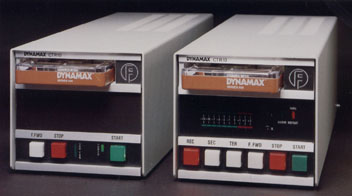
For the past twenty years, broadcasters have used cart machines as a standard playback device for in-house audio. Only the infiltration and growth of digital audio in radio studios really put an end to it. The cart machine was reliable and functional. Before cart machines, commercials were played back via reel to reel machines. The DJ had to thread the tape, then manually cue, and rewind the tape.
The cart machine solved these problems but brought along it’s own issues. No two brands of cart are made exactly the same. The small differences caused by the manufacturing processes prevented exact alignment of the cart machine to more than one cart! The irregularities of each cart usually cause phase problems between the left and right channels in stereo models, and in severe cases a miss-cue.. As the lifetime of the Cart wore on, it also became clear that we all were recycling our carts for far too long. Old carts sounded worse than a beat up 78 rpm platter. But at least I never had to reboot a cart machine during my show. More here and here.
Subscribe to:
Posts (Atom)

 Posts
Posts


