Thursday, May 31, 2007

E-Skip

Skip normally refers to the distant reception of AM radio stations via signal echos reflecting off the ionized night troposphere. Its present in other bands, in other contions as well though. It's assumed by many to never occurr in the FM band. It does happen, but in for different reasons and with a different cause. But the end result is the same, a long single hops of E-skip can travel 1500 miles.

E-skip is more often mentioned in context with television DX. But it can occurr in the FM band as well. E-skip occurs only when patches in the E layer of the ionosphere become ionized. The E-skip patch must be at approximately the midpoint between the transmitter and receiver. Sometimes the patches failry stationary, but also can move at speeds of several hundred miles per hour. Movement is typically in a straight line but not always. There can also be multiple seperate E-skip patches allowing for "double skip"or double hop to occurr. More here.

The cause of E-layer ionization is not precisely known. The multiple theories disagree on cause but low pressure areas and thunderstorms are both popular culprits. Surface weather has a poor causal relationship, it's more likely symtomatic of the mutual cause... Neat E-layer map here.
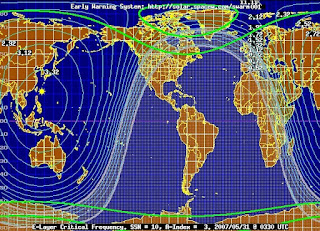
An E-skip episode usually up to a few hours and usually in the middle of the day. The season for E-skip peaks in the months of May and June. In coastal areas, that same season also induces tropospheric ducting, which can carry signals hundreds of miles. Try not to confuse the two. maybe I shoudl expalin that tomorrow...

Tuesday, May 29, 2007

Moon Bounce or EME

It wasn't as as climactic as the moon landing, but still signifigant in radio land. The technique is known today as Earth-Moon-Earth (EME) or moonbounce. Signals of very high power are transmitted from antennas pointed at the moon 238,000 miles away. The moon reflects some of the signal and bounces the radio waves back to Earth to be received by listeners about 2.7 seconds later. The moon only reflects back about 7 % of the signal during a Moonbounce so this is harder than it sounds.

On January 10, 1946 , John H. DeWitt Jr. of the US Army Signal Corps bounced a 112 MHz (2.6 meters) radar beam off the moonThis was the first EME transmission. John was from Nashville and had been a Ham since 1921. He joined the US Army Electronic Branch in 1942. Two years later, he became director of the Evans Signal Laboratory at Belmar, New Jersey.

He actually beat out another radioman trying for the same acheivement in Hungary. Zoltan Bay suceeded in his first EME a mere two weeks later with radar of 2.5 m on february 6th. The first scientifically useful radar echoes, however, were those made by Frank Kerr and Shain. On November 1947. Kerr, shain and the crew at CSIRO demonstrated with a 15m echo that the short period variations of Earths rotation were caused by the vibration of the moon.
DeWitt just took that eperience and developed radar for locating mortars and directing counterfire. http://www.elite.net/~k7xq/eme.html He later returned to Nashville and broadcasting, eventually becoming president of commercial radio station WSM.

Monday, May 28, 2007

NEW SIS, NEW REVIEWS

Various artists - 8 Bit Operators
Zozobra - Harmonic Tremors

...and more on the way, issue #6 impending.

Saturday, May 26, 2007

Owned.

It is rare in my limited topic arena that another blog "scoops" me. but for some time I've been brewing a post of all songs about radio. It's a big arena, so being comprehensive would be nearly pointless. My notion was to make a tight list of maybe a dozen songs that were thematically related to a news event.

He got me. damn

Friday, May 25, 2007

FREE FM IS DEAD!

Long live K-Rock!
www.923freefm.com redirects to http://www.923krock.com/ and even the cache has been wiped so as to fully stalinize the aborted format. The first song played upon the return of WXRK K-rock was "All apologies" by Nirvana, right after Tom Chiusano apologised personally to the denizens of New York.

Free FM wasn't a flop entirely, it actually created some really high quality talk programs that I expect will persist elsewhere under other brands. But it's genus was in the departure of the greatest and most popular DJ in the history of radio. Howard Stern (whatever you may think of him) is to Radio as Elvis is to Rock n' Roll.

Stern was driven out of terrestrial radio by the FCC. The battle became so personal that Stern called KGO-AM to argue with then chairman Michael Powell during what was otherwise a civil and pithy (if not dull) interview. So Stern left for satillite. He was syndicated on hundreds of radio stations and then the carpet was pulled out. Infinity panicked, killed the active rock, alternative rock and rock formatted stations that bookended his daily program. Most of them became Free FM after Stern signed off.

The transition was a grotesquely long audio montage of TV and movie samples, manipulated music, static, Lawrence Fishburn mumbling about being imprisoned and Donald Trump joking with David Letterman about lesbians. The production effort was pretty impressive, but it stands value-wise as the total opposite of what WUBA did just last week. The entire WFNY montage went on FOR OVER SEVEN HOURS without repeating! I've got the audio but nowhere to put a solid hour... I've got a sample here with Tom's contrition speech.

(I'm trying Files.ww.com we'll see how that goes)

Marine VHF Radio

Do you remember that scene in Jaws where Quint (played by Robert Shaw) snaps and smashes the radio to keep Brody from calling the Coast Guard for help? That radio was a VHF radio...

By law, the operator of a marine VHF must obey the FCC provisions aplicable to that device. Although possession of the Rules and Regulations is not required, they may be obtained from the Superintendent of Documents, U.S. Government Printing Office.

Marine radio is actually quite critical. Weather on the water changes rapidly, especially in certain seasons. The ability to seek shelter on the water is limited. Thus that communications link for the boating community is critical for the safety of all boaters. http://www.boatsafe.com/nauticalknowhow/radio.htm

Marine radio is not unregulated like Ham radio. The FCC operates monitoring stations that monitor marine VHF transmissions listening for incorrect operation of marine stations. Sophisticated equipment provides for tracking violators through "voice prints" of transmissions made on the radio.Willful or repeat violators may receive a "Notice of Violation" citations, and be fined up to $2,000! You can see a chart fo what frequencies are for what types of messages here.

Boaters should normally use channels listed as Non-Commercial. Channel 16 is used for calling other stations or for distress alerting. Channel 13 should be used to contact a ship when there is danger of collision. All ships of length 20m or greater are required to guard VHF channel 13, in addition to VHF channel 16, when operating within U.S. territorial waters. http://www.sacdelta.com/safety/radio.html

Technically recreational vessels less than 66 feet in length are not required to have VHF radios. but if you plan to travel more than a few miles off shore, you should get a VHF radio, an emergency position indicating radio beacon, or EPIRB, and a second VHF radio or cellular telephone as well.

Thursday, May 24, 2007

Radio begets crooning

Yeah, no kidding. The singer Vaughn De Leath supposedly is the inventor of "crooning." A style of singing not beget by amorous cooing but instead a method of singing adapted to match the limited range of early radio equipment.

At the time the high notes hit by soprano singers often broken delicate transmitter tubes. Try to recall that at the time most radio listeners were using crude cat whisker crystal radio sets. She was compelled to sing in a soft voice, now called crooning so that no loud and or high notes would over-modulate and destroy the expensive and delicate transmitter power output tubes.

"According to Ben Gross of the New York Daily News, after her first broadcast, Vaughn received one of the first radio fan letters ever written; it read "You have inaugurated a new form of song which, no doubt, will become very popular." I understand her comp on Document Records is quality.

She was an early famous female radio jazz singer who gained popularity in the 1920s and became known as "The Original Radio Girl" and "First Lady of Radio". She was born as Leonore Vonderleith in the Midwestern town of Mt. Pulaski, IL in 1894. While at Mills College, she began writing her own songs, but later dropped out to pursue a singing career. Later she changed her name to Vaughn De Leath. Some Real Audio here: http://vintage-recordings.com/vocalshow2.html

She sang at 770 WJZ-AM (WABC today) In 1923, she became the first female executive to run a radio station, WDT-AM, along with a small network of power stations. She routinely appeared on the Wrigley Show during the mid twenties. In 1931, she appeared on an experimental television broadcast. That same year, she sued Kate Smith and won an injunction preventing Smith from using the "First Lady of the Radio" name. Smith laid off until Vaughn to croaked, then started right back up.


In 1922 she began recording on different labels, including Edison Records. But at the time Edison was transitioning from vertical cut discs to lateral cut recordings. Edison didn't' issue any lateral cut recordings until 1929. So much if thsi material was shelved, even as test pressings. In the mid 1970s these were rescued and finally released; 30 years after her death from complications sue to cirrhosis.

Tuesday, May 22, 2007

again. road the On...

More travel, be right back.

On the road anagrams:
Date Honor
Hoard Tone
Neath Door
Hate Donor
Oath Drone
A Hot Drone
No Red Oath

Saturday, May 19, 2007

The Broadcast Flag

This front has been quiet for about a year. It's probably safe to discuss it, air it out, and explain the situation for benefit of everyone now that the fires out.
The problem was (and is) the illegal use of copyrighted media. The Brodcast Flag was a technology fix by record labels and movie studios to stop piracy. ...Well, they said it was to stop piracy but the big hammer solution they sugested also stopped all kinds of perfectly legal uses too. What they wanted was to prohibit the manufacture of computer or video hardware without copy protection technology embedded.

For radio this was about the BROADCAST FLAG!. Officially it was referred to as "Digital Broadcast Television Redistribution Control," or the FCC's rule is in 47 CFR 73.9002(b) and the following sections, stating in part: "No party shall sell or distribute in interstate commerce a Covered Demodulator Product that does not comply with the Demodulator Compliance Requirements and Demodulator Robustness Requirements."

n translation... All HD radio and HD TVs will monitor for a "broadcast flag." the device now being remotely monitorable and usable to delete, stop, block and restrict content use. So you cant tape the radio, your favorite shows, nor edit out the commercials when you are allowed etc... This was all intended for television but it took all of 10 seconds for the fiends to realize that radio could go down the same way. More here. One represantative Rep. Lamar Smith,went as far as saying the FCC “might issue rules that impact the Copyright Act.” A gross understatment.

The flag itself woudl have been a sequence of digital bits embedded in a television or radio program that signals that the program must be protected from unauthorized redistribution. It would be invisible and not alter the program audibly or visibly. Thsi technology has existed for a decade.. its called a watermark. More here.

Seems lame but in fact also illegal. You are totally allowed to tape the radio right now. You can do that. But desipte that, the FCC wants to stop it, or to be able to stop it. Or to at least make you sit thru the advertisements when you do. That really sucks. Especially for all those people that like their Tivo so much. Best explained by this comic.

It was so blatantly over the line that even the United States Court of Appeals for the D.C. Circuit ruled that the FCC had exceeded its authority in creating this rule. The FCC only has authority to regulate communications, not devices that receive communications. So this illegal backroom attampt by the Bush administration was thwarted. It was so blatantly illegal that even his ditto-head congress wouldn't touch it. It was allowed to die.

So now as will all truly criminally bad, and ill-minded peices of legaslative groupthink we all await for it's inevitable zombie-live return from the dead.

Friday, May 18, 2007

What's in a signal part 2

So that's all the stuff you can hear. Here's everything else. But, let me warn you now, that under Electronic Communications Privacy Act of 1986, it is illegal for you to monitor these transmissions. I have no idea why. It's not really that exciting and they can't tell you're doing it anyway. Unenforcible laws are just silly. So here's what you can't hear.

Stereo Beacon or Reference Signal: This unmodulated subcarrier is transmitted at 19 kHz. This is lets the FM stereo receiver know that the broadcast is in stereo. The receiver doubles the frequency of the pilot tone and uses it as a phase reference to demodulate the stereo information.

Subcarrier
A subcarrier is totally different than a reference tone. The SCA can carry data. This separate signal is carried on the main radio transmission. More technically, it is an already-modulated signal, which is then modulated into another signal of higher frequency and bandwidth. This is in some ways similar to the multiplexing that's the big excitment (ho-hum) in HD Radio. I've talked about that before as well.

But there's all kinds of data in an SCA. That Horrible easy listening music you hear in the evevator or dentist office, Reading services for the blind, Foreign language news services, and theres a growing variety of data transmissions.

A typical FM broadcast may contain anywhere from 2 to 12 subcarrier voice channels in addition to the main signal, and subcarriers may havesubcarriers of their own. Sounds wildly complicated right? A lot of surveilance devices use these frequencies as well http://tscm.com/bugfrqVLF.html

I also caught an interesting note about Fireworks in Los Angeles using a 92 kHz SCA:
"a man was just reciting numbers, mostly one-at-a-time, but sometimes two." I'm not from KXLU, nor was I involved in that particular fireworks show, but as a fireworks pyrotechnician (one of my sidelines), that sure sounds like firing queues to me. It's becoming far more common to coordinate fireworks shows with music from radio stations and using sub-carriers is a common way to do that" I cut the identifiers out of that because it's not legal to have heard it. oy.

Wednesday, May 16, 2007

We interrupt this demodulation

First of all I want to point out that I predicted this format wouldn't last in Philly given the demographics. But this isn't about bragging. I wanted to point out how artful their very breif transition was. They faded out a tropical latin song and then dropped about 10 seconds fo silence. Then the breaker. Divshare is fucking up today. Trying Zshare... http://www.zshare.net/audio/wuba2-mp3.html

Notice how it emulates Am interference, advertisements from 20 years ago, the song selection for the first track... I've seen statiosn stunt for weeks on an impending format -total overkill. This was graceful, sleek and simple. Good job boys.

Of course this is a hot topic today:
http://carnyfeet.blogspot.com/2007/05/1045-flips-to-alt-rock.html

http://www.thirteen.org/blogs/index.php?itemid=152

http://www.fmqb.com/Article.asp?id=407887

What's in the Signal Pt 1

There is more to radio than what you hear. I dont mean all the goings on behind the mike. I'm referring to the signals in the broadcast that you can't hear. The audio you hear is data on a carrier wave. There is more to it than audible sound.

There are 100 possible FM channels between 88.1 and 107.9 MHz. These are allocated in 200 kHz increments. Because of limited bandwidth a radio station can only transmit audio which is up to 100 kHz. But hey, that's still much wider than the range of human hearing. In practice, FM audio is usually restricted to 15 kHz. This leaves a lot of spectrum for other uses. FM Stations are permitted to place subcarriers in this unused portion of the spectrum.

Here's what's on that carrier wave that you can hear:
Normal baseband audio: consists of the right and left audio mixed together (R+L). This is so that when listening on a mono receiver, you hear both channels of sound.

Difference signal: This is harder to imagine, it's the difference between the right and left channels. When a songs in stereo both ears are getting very similar but not exactly the same audio. This is just the parts that are different or (L-R). This is transmitted on a 38 kHz subcarrier using FM modulation.

Mind blowing isnt' it? FM radio does not broadcast the Left and Right Channels. It's not a damn think like the channels on a cassete tape. Here is how how stereo audio is decoded. Of course, as much of a genius as Edwin Armstrong was, it was nto his system that gave us stereo audio. The Armstrong system was rejected by the FCC because it did not allow sub-carrier services. The the Zenith system has gone on to become the standard method in most countries.
The Armstrong system was more noise resistant I understand. Instead today's stereo FM signals are far more susceptible to noise and multipath distortion than mono FM signals. This is due to several factors, including the following:

1. the addition of the two sidebands of the difference subcarrier to the baseband signal increases the noise bandwidth of the signal by a factor of three (9.5 dB) as compared with a mono signal.
2. The pre-emphasis is applied to the audio signals results in the pre-emphasis acting in the wrong direction on the lower sideband of the difference subcarrier, i.e. decreasing the level as the frequency rises, which will have a further deleterious effect on the S/N of the difference signal. yadda yadda , I know thats too technical. Btu I cant think of a way to simplify it.

So heres what we got and how it works:
If you fed the baseband audio into a receiver's antenna input it will demodulate the signal. This demodulated signal would be the R+ L audio. If you combine this with the Difference (R-L) signal you get a mess, but that's kind of how it works. What it does is add the R+L and R-L signals, leaving just the right (R) channel. the remainder being the LEft channel left (L) channel. ta-dah!

The upside of this complexity and reduced reception qualityis that mono and stereo stations can all operate with this system as can all FM tuners. Also side bands can exist and aren't those nifty. More tomorrow!

Monday, May 14, 2007

The First Free-form DJ

It's a hard point to argue. Before there were formats, technically everything was free form in a way. Really before about 1935 it was hard to tell who was taking radio seriously and who was not. In 1947 It was abundantly clear that Jim Hawthorne was not. NOTE: not to be confused with James Hawthorne of the BBC or the other Jim Hawthorne a well-known but unrelated sportscaster.

Many operate under the assumption that free-form radio as we know it today began on 94.1 KPFA Berkley, CA. The first NCE licensed station in America and crown Jewel of the Pacifica Network. But it was not so. Before they took to the air Jimbo was running amok. On his show at 1110 KXLA-AM, he played a blizzard array of Buddy Baker, Spike Jones, Red Ingle, Slim Coates, and all without regard to genre and format. That was way back in 1946! Some sources, like and AWA Journal cite the start as in 1948, but there is an announcement [SOURCE] in the May 13, 1946 issue of Broadcasting which confirms. Variety magazine announced it over a year later in August of 1947 which probably is the source of the confusion.   (Note: KXLA became KRLA in 1959.)


His popularity was such that in 1950 he managed to score a late night talk show on KLAC-TV it was kind of a predecessor to NBC's Saturday Night Live according to the Los Angeles Times. He landed some spots in some movies and even did some pre-3-stooges reels for film. Everything he did was counter to radio culture at the time.

His effect was barely noticed while he was active in broadcasting. It's only now that in looking back you can see the effects ripping outward. His zany all night weekend show on KOA radio was the stuff of legend. WFMU has a little tribute page here. and his fan club is here.

He's got a radio pedigree a mile long. This is far from complete...

  • KMYR Denver 1941 - 1946
  • KXEA - 1946 - 1946? 
  • KXLA Los Angeles, 1946 -1948
  • KECA Los Angeles, 1948 -1950
  • KNX Los Angeles, 1950-1952
  • KCBH Los Angeles, 1952 -1955
  • KYA San Francisco 1957 -1959
  • KDAY Los Angeles, 1959 -1960
  • KFWB Los Angeles, 1960 - 1963
  • KOA Denver, 1974-1981-1984
  • KIEV Los Angeles, 1991

Today Jim Hawthorne is 88 years old, living in a retirement home in Santa Barbara, California. He's grown comicly cantankerous bemoaning the state of modern radio, it's voice-tracking and control by megacorporations. He still does a local TV show in Santa Barbara four times a year

Friday, May 11, 2007

Quick Trip

I'm on the road; will be back Monday.

Casey Kasem & WJBK

This Detroit station launched the career of Casey Kasem. Its hard to say today wether that was a pro or con culturally, but the man has fans. That's inarguable. Anybody ever hear that audio of casey complaining about a callers deceased pet? It's worth the click I assure you.

WLQV-AM is that magical station. Their 50k watt daytime signal reaches south to Toledo, and from Lansing, Michigan to Chatham, Ontario, Canada. These days they run a bland Christian talk format. but that's not how it used to be. Once long ago they mattered in the world of rock n' roll.

They first signed on as 1290 WJBK-AM in 1925, licensed to the suburb of Ypsilanti. Two years later, WJBK moved to 1360 and in 1930, to 1370. In 1940, WJBK was re-licensed to Detroit on 1490 AM. It was all but acedemic at that point. They'd already been a detroit station for decades. In 1954, they moved to its current dial position at 1500 AM. In 1956, WJBK became the first radio station in Detroit to feature the Top 40 format.

It was then that Casey arrived. He left his part time gigs at WJLD and WXYZ and because "Casey at the mike" for WJBK. He did awful thankless jobs radio acting, dressing as a clown, and late night shifts. He literally had to take off his Krogo the Clown make-up in four minutes or else do his radio show in a clown suit. He didn't' start counting down for another 13 years.

Kasem left Detroit’s airwaves in late 1957 for radio stations in Cleveland, Buffalo, Oakland and eventually Los Angeles. It was in Oakland where he developed his unique style of introducing songs with uplifting stories about the lives of music artists. American Top 40 with Casey Kasem made it’s syndicated debut on July 4, 1970. For more than thirty years Kasem counted down the hits, until his last AT-40 broadcast on July 7, 2004.

Wednesday, May 09, 2007

Breakfast with the Johnsons

Reality TV has been an exploding genre since that pasty and trite "Real World" sham graces the cablevision universe with it's debut on MTV in 1992. Twenty seasons later a hundred similarly conceived TV programs have come and gone, and nobody has yet to refer to where reality programming began.

Before reality television there was reality radio. Reality radio, began it's first contrived motions in 1952 on WBBM-AM. It was a half-hour radio show hosted by Cliff Johnson from the kitchen of his Oak Park home. It ran for 10 years.

The show was basically arranged around a breakfast table in the Johnson home. The characters be they real or otherwise were: breadwinner Mr. Johnson, homemaker /wife, Luella, and four daughters, ages 2 to 10: Linda, Pamela, and Vicki. The family pet was a parakeet named Olaf. It died and was mourned on-air. When Mrs. Johnson became pregnant with Cliff Jr. the cast expanded. Read more here.

Girls chatted about school and boys boys, were prominent characters. It mirrored real life in that era milkman and mail man included.

At 7:30 in the morning, Monday through Friday. The microphones were installed all over the Johnson home. Children would wandered in, and the milkman would come in. They talked about each other, Chicago, and the world. It was like Oak Park, IL had its own radio show.

Clifford Johnson was born on a dairy farm in Beresford, SD. He married Luella in 1938. they relocated to Lincoln and it was there that he got a job with the Central States Network. his good reputation there got him a gig at KOIL in Omaha. That high profile gig led him to WBBM in Chicago in 1941.

First he was was host of "Meet the Missus", then "Shopping with the Missus", and "Listen to Cliff". His eponymous show caught the notice of Philip K. Wrigley, who brought him on board at KNX. There he filled in for Jack Bailey during his show "Queen for a Day" and once for Art Linkletter and his segment "Kids Say the Darnedest Things." It was that show that supposedly inspired Cliff to dream up "Breakfast with the Johnsons."

After 10 great years at the breakfast table, Cliff moved on. He became host of "Sounds of Europe." He received the Dwight Eisenhower Award for his news work there. He was managing editor from 1964 to 1968 at 1390 WNUS-AM. Then at the age of 77 he went back to college earned a degree in theology and one on communications. he spent the remainder of his life volunteering and doing community work. In 1993 the Illinois state assembly honored him with a resolution deciding his life's accomplishments.

The many calls of Facility ID #135143

WLIZ-LP 92.9 Gap PA changes calls to WLAL-LP, its 15th call change in four years. Will somone please explain this to me? http://www.geocities.com/wliz929/


Call Sign - Begin Date
WLAL-LP 04/23/2007
WLIZ-LP 03/12/2007
WPAG-LP 08/17/2006
WOMB-LP 07/01/2006
WTPP-LP 06/13/2006
WLIZ-LP 05/01/2006
WLRI-LP 09/15/2005
WOBS-LP 05/16/2005
WLBX-LP 05/09/2005
WGPQ-LP 04/20/2005
WOBS-LP 12/20/2004
WLDW-LP 10/16/2004
WOMB-LP 05/12/2004
WGCP-LP 04/23/2004
WOMB-LP 10/27/2003

Tuesday, May 08, 2007

The first stations in each state

I didn't do the research on this, but I did check their list twice. And rearranged it into chronological order. It's a list of the first licensed radio stationin each state. Well all know KDKA, and WQAM, and WBZ but the rest are surprises. Also surprising is how long some states took to get it together. It's very interesting, and the rest of the National Radio Club website is also well worth the browsing.http://www.nrcdxas.org/

Pennsylvania KDKA Pittsburgh Oct 27 1920
California KQL Los Angeles Oct 13 1921
Connecticut WCJ New Haven Sep 29 1921
Florida WQAM Miami Feb 1921
Illinois WDZ Tuscola Mar 17 1921
Indiana WGAZ South Bend Sep 25 1921
Mass. WBZ Springfield Sep 15 1921
Michigan WWJ Detroit Oct 13 1921
Missouri WEW St. Louis Apr 26 1921
Nebraska WOU Omaha Dec 29 1921
New Jersey WJZ Newark Jun 1 1921
New York WJX New York Oct 13 1921
Ohio WLW Cincinnati Mar 3 1921
Oklahoma WKY Oklahoma City Apr 21 1921
Texas WRR Dallas Feb 1921
Washington KFC Seattle Dec 8 1921
Alabama WGH Montgomery Feb 3 1922
Arizona KFAD Phoenix Jun 21 1922
Arkansas WOK Pine Bluff Feb 10 1922
Colorado KLZ Denver Mar 10 1922
Delaware WHAV Wilmington Jul 30 1922
Georgia WSB Atlanta Mar 15 1922
Hawaii KGU Honolulu May 1922
Idaho KFXD Logan Utah 1922
Iowa WOC Davenport Feb 18 1922
Kansas WEY Wichita Mar 23 1922
Kentucky WHAS Louisville Jul 18 1922
Louisiana WWL New Orleans Mar 31 1922
Maryland WKC Baltimore Mar 23 1922
Minnesota WLB Minneapolis Jan 13 1922
Montana KFBB Great Falls Jul 11 1922
New Hampshire WKAV Laconia Aug 1922
New Mexico KOB Albuquerque May 1922
North Carolina WBT Charlotte Apr 10 1922
North Dakota WDAY Fargo May 23 1922
Oregon KGG Portland Mar 15 1922
Rhode Island WEAN Providence Jun 5 1922
South Dakota WCAT Rapid City May 9 1922
Tennessee WKN Memphis Mar 23 1922
Utah KZN Salt lake City Apr 21 1922
Vermont WCAX Burlington June 1922
West Virginia WHD Morgantown Mar 16 1922
Wisconsin WHA Madison Jan 13 1922
Virginia WTAR Norfolk Sep 21 1923
Alaska KFQD Anchorage Apr 1924
Maine WCSH Portland Jul 24 1925
Mississippi WDBT Hattiesburg May 1 1925
Nevada KOH Reno Oct 25 1928
South Carolaina WSPA Spartanburg Nov 1929
Wyoming KDFN Casper Jan 2 1930

Friday, May 04, 2007

Shortwave Music

No post today, instead I refer you to the posts of another radio man.

Music on Shortwave radio is not a hi-fidelity stereo experience. Its mono, it's noisy, it's marginaly listenable actually. yes some stations perservere, perhaps obstinately in their regular programming. It's often from thousands of miles away, and almost exclusively DX.

Myke Weiskopf records, collates, contextualizes and posts semi-regulay about it here:
http://shortwavemusic.blogspot.com/

He's got clips from VOIRI, Radio Kuwait, FEBA Radio, HCJB, Radio Cairo, VOA, All India, KJES, NHK, and many more. Of particular interest is his taste for the way that Shortwave decimates, rearranges and alters the sound of even recognizable songs. He has a version of CCRs Suzie Q that sounds like it passed through a broken Moog, but really it just bounced off the atmosphere...

Thursday, May 03, 2007

KHAT on a flag pole

Flag pole sitting is an American tradition. For the most part Flag pole sitting died out in popularity in the late 1930s. It had peaked with the extreme stunts of Alvin "Shipwreck" Kelly. In 1924, Alvin went to Atlantic City and sat atop a flagpole for a record 49 days. 20,000 easily entertained people watched.

Radio of course has always had trouble letting a joke die. We drag that crap out forever squeezing out every possible guffaw until it's desperate and painful to listen. So it came to pass that 20 years after the joke was a dead horse, KHAT radio personality Roller rehashed it. the year was 1958 and he spent 211 days and 23 hours sitting on a flagpole at a Ford car dealership in downtown Phoenix. His twist on the crank move? It was in a Ford Fairlane mounted atop the pole.

It was dumb enough that area rockabilly artist Al Casey cut a song about it. Casey never became a big name, I think his career peak were his few TV seasons playing in the studio band on Dean Martin's NBC variety show. His local fame really comes from his time in The Sunset Riders, the then house band for KRUX disc jockey Ray Odom on his Arizona Hayride shows.


KHAT was a relatively new station at the time having only signed on in the late 1950s as a daytimer. They played country music well into the1970s when they killed it for news/talk as KPHX. N?T didn't stick for them (like many daytimers) So about a year later they went Regional Mexican. In 1982 they got a repreive from the FCC and were allowed to begin night-time operation at a reduced wattage, directional. they run Air America these day harkening back to their breif mid 70's News stint. http://www.1480kphx.com/

Cult attacks High School!

I recently got a hostile comment from a religious fanatic that did not approve of my take on the RB Schools manuvers in the midwest. To recap: A large satcasting religious group attempted to seize airtime from underfunded highschool stations illegally and fails. the fanatic actually informed me that RB Schools is owned by EMF, which I did not know, and makes the manuvers even more heinous.

I've hit this topic before, but it was reassuring to see logic and fairness rule at the FCC. My take, before we get to an update on their movments... I thinkthat jesus can be on the radio, it's ok. But My preference is that it be in the hands of a local religous group, with locally originating programming and not be satellite fed religious programing. The NCE stations are traditionally for local groups. taking airtime from them and giving unto an undeserving group from another community is wrong. Thankfully I, the law and the FCC agree.
I have Quote here verbatim from Radio Journal, so no one can claim that "I" inturpret the events innaccurately. I think we can all agree it's a reputable tip sheet, well worth the weekly read: http://ftp.media.radcity.net/ZMST/Journal2/Journal.pdf

The next chapter in the never-ending Indiana share-time saga. We’ve reported on Marty Hensley’s attempts to force many of Indiana’s school-owned noncom FMs into involuntary share-time arrangements. The FCC’s routinely shot those applications down — noting that the stations in question are now operating 24 hours a day, immunizing them from share-time challenges. But Hensley’s not giving up. He filed for “recon” — petitions to reconsider the FCC’s licenserenewal grants for high-school stations WEEM, Pendleton, IN (91.7), WBDG, Indianapolis (90.9), WRFT, Franklin Township, IN (91.5) and WHJE, Carmel, IN (91.3). The FCC rejected all those petitions, noting that it had already rejected Hensley’s claims. Those included claims that the school stations violated the RICO statues when they coordinated their efforts to fight Hensley, and a claim that the schools violated Indiana law by having the wrong officials sign their applications. So the school stations keep their licenses — but at how much taxpayer cost for legal fees?

Another share-time applicant loses, this time in Illinois. “RB Schools” has been the other major player, besides Hensley, in the Midwest share-time battles. It just lost its attempt to force a share-time against Millikin University’s WJMU, Decatur, IL (89.5) — but at a price for WJMU. The FCC found that RB hadn’t properly attempted to negotiate a voluntary share-time with
WJMU, as it was required to do. It dismisses the RB application. But it also admonishes Millikin for improper “ex parte” contacts with the Commission, including asking two area Congressmen to intervene on the school’s behalf.

Wednesday, May 02, 2007

Hospital radio goes Public

Radio stations were founded by unexpected organizations in many unexpected places. Here's one that grew and prospered. In this case the owner, Albany Medical Center was the source of the call letters WAMC. The WAMC Northeast Public Radio Network, and it's Performing Arts Studio, a venue in Albany all have their genus in the same place.

In 1955 Albany Medical Center received a small grant from the Rockefeller Foundation to broadcast two-way radio conferences among physicians. This clearly gave them the radio bug as the pilot program of six hospitals grew to 24 in less than 2 years. By 1958 they'd started their own FM radio station WAMC on 90.3 FM as a classical music outlet.

Albany Medical Center continued on as a ACGME accredited medical school. Its influence on programming was clearest in the early days when brodcasts included health information and lectures from visiting professors. But in 1962, a hint of their later politicking they carried first live hearing from Washington, D.C. on programming practices.

In 1970 when the NPR was founded in 1970, WAMC became one of their first 90 charter stations. but things were growing quickly, the hospitcal could not contain everythign that WAMC was bustling to become. In 1981, financial pressure peaked and the hospital divested the station. The FCC license was transferred to a non-profit, tax-exempt entity, WAMC, Inc. It's five incorporators included then CEO Alan S. Chartock, the State University of New York and New York State government.

WAMC has grown into a network of fourteen stations serving portions of seven New England and Middle Atlantic States. They have been an aggressive station that's expanded their network for 2 decades, highlights including the 1989 purchase of WBBS in 1989 (now WAMQ) and in 1995 WAMC outbid SUNY Plattsburgh for 91.9 WCFE (now WCEL) Coverage Map here.

Soon they'll be on 99.3 in Oneonta I hear. Sadly this will kill the local repeater of the somewhat obscure WDHI oldies Network. But as many radiomen will tell you, in this buisness it's grow or die. A lesson you should take into this falls NCE auction.